

SAP S/4HANA Integration & Automation
- Automate
- Sync
- Scale
SAP S/4HANA integration connects your SAP S/4HANA ERP, on-premises, cloud, or hybrid, with eCommerce, CRM, and marketplace applications so customers, products, orders, inventory, and invoices move automatically between systems. Once connected, web orders create S/4HANA sales orders, S/4HANA updates propagate across CRM and marketplaces, and invoices flow back, with no manual steps.
APPSeCONNECT is an ERP-first iPaaS that connects SAP S/4HANA through its OData and BAPI APIs, with templates that also cover ECC, Business One, ByDesign, and All-in-One. Pre-built ProcessFlow templates and a drag-and-drop designer support on-premises, cloud, and hybrid S/4HANA landscapes.
Key Highlights
Why APPSeCONNECT is The Gold Standard for SAP S/4HANA Integration & Automation
APPSeCONNECT connects SAP S/4HANA to every eCommerce, CRM, marketplace and many other business applications your team relies on in real time, without manual work. One governed platform built for enterprises running S/4HANA on-premises, cloud or hybrid across multiple regions.
Manual order entry into S/4HANA
An enterprise runs S/4HANA but staff still re-key web and marketplace orders into the ERP by hand.
Hybrid landscape is hard to reach
A mix of on-premises and cloud S/4HANA means integrations have to reach both sides safely, which fragile scripts cannot.
Generic iPaaS breaks on SAP protocols
Generic tools lack native support for SAP proprietary protocols, so S/4HANA integrations stay fragile and high-maintenance.
Inventory inaccuracy and overselling
Stock in S/4HANA and stock on the storefront drift apart, so you oversell across channels and disappoint customers.
Supply chain stays disconnected
Complex supply chains need S/4HANA linked to warehouse, shipping and supplier systems, not just the storefront.
Per-region scripts do not scale
Multi-region operations end up with brittle per-region scripts instead of one governed integration layer.
Popular SAP S/4HANA Integrations
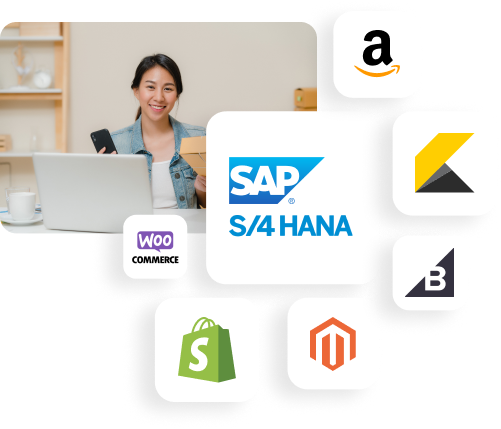
APPSeCONNECT makes it easy to connect SAP S/4HANA with the apps you already use. Common integrations include:
+
SAP S/4 HANA and Magento
+
+
+
+
+
+
+
+
+
+
+
+
Looking for a Specific Integration?
View All Apps
What You Get
Features You Get With Our SAP S/4HANA Integration
A strong SAP S/4HANA integration should help teams move records, check issues, and keep business work connected. APPSeCONNECT gives teams a managed way to connect SAP with the systems around it.
Ready SAP S/4HANA Flows
Teams can start with ready integration patterns instead of building every flow from scratch
Two-Way Data Sync
Records can move between SAP and connected systems, so teams do not have to check both sides manually
Order-to-Cash Support
Orders, invoices, payment updates, and shipment details can move through one connected process
Product and Pricing Sync
Product records and approved pricing details from SAP can reach connected sales channels
Monitoring and Retry Tools
Teams can review failed records, understand the issue, and retry after the fix
Cloud and Hybrid Setup Support
SAP S/4HANA can connect with cloud systems, on-site systems, or mixed setups based on the business stack

INTEGRATION BROCHURE
Download The Full Integration Guide | ISO 27001 Secured
Get the complete reference on how APPSeCONNECT connects SAP S/4HANA to your business stack, from architecture to deployment.
Inside you’ll find:
- Reference architecture using S/4HANA OData and BAPI APIs across on-prem, cloud, and hybrid.
- Sync coverage for customers, products, orders, inventory, shipments, and invoices.
- Supply chain integration patterns for warehouse, shipping, and supplier systems.
- Deployment roadmap with prerequisites, timelines, and team responsibilities.
- Security model, hybrid agent setup, and exception-handling reference.
Real-world use cases
See how businesses use SAP S4/Hana
SAP S/4HANA integration can support different teams that depend on SAP as the main business system. The goal is simple: reduce manual work and keep SAP connected with the systems used across the business
Manufacturing & Distribution
Manufacturing Sync: Real-Time Integration for Efficiency
Manufacturing teams run production orders, BoMs, MRP runs, and quality inspections inside SAP S/4HANA. Integration keeps shop floor systems and planning tools connected without manual re-entry or batch delays.
- MES Connects to SAP Production Orders: Order status and shop floor confirmations move between MES and SAP PP in real time.
- MRP Live Gets Fresher Data: Stock movements and supplier updates from connected systems trigger immediate MRP recalculation, not overnight.
- IBP Plans Flow Into PP/DS: Approved demand plans pass directly into PP/DS, keeping scheduling aligned with S&OP.
- Quality Results Post Into SAP QM: Inspection outcomes from lab or IoT systems post into SAP QM and trigger notifications automatically.
What this integration handles
Production Orders
Sync order status and confirmations between SAP PP and MES
PP/DS Scheduling
Move demand plans into SAP PP/DS for capacity and production scheduling
Quality Management
ost inspection results into SAP QM and return notification status to connected systems
MRP Live
Feed real-time stock and demand changes into SAP for current planning
eCommerce Distribution
U.S. Tobacco: Automated Order & Inventory Sync
U.S. Tobacco connected WooCommerce with SAP S/4HANA across its business operations. The integration helped automate customer data, sales orders, stock levels, and delivery details that were earlier moved by hand.
- Order Processing Gets Faster: WooCommerce orders can move into SAP without manual transfer.
- Stock and Delivery Data Stay Updated: Inventory and delivery details can move between WooCommerce and SAP.
- Customer Records Stay Connected: Customer information can sync between the store and SAP.
- More Apps Can Be Added Later: The setup can support more connected applications as the business grows.
What this integration handles
Order Flow
Move WooCommerce orders into SAP S/4HANA
Inventory Updates
Sync stock levels between SAP and the store
Customer Records
Keep customer details connected across both systems
Delivery Details
Share delivery information between SAP and WooCommerce
Wholesale & Distribution
Wholesale & Distribution: SAP S/4Hana Integration for Orders & Finance
Wholesale and distribution teams often manage B2B orders, channel sales, pricing rules, and stock updates through SAP. Integration helps keep these records moving without extra manual checks.
- Marketplace Orders Reach SAP: Orders from connected marketplaces can move into SAP for processing.
- Pricing Rules Stay Managed: SAP price rules can support cleaner order handling across channels
- Stock Data Supports More Channels: SAP inventory records can help connected channels show better availability.
- Finance Gets Better Inputs: Payout, refund, invoice, and adjustment records can move into SAP where needed.
What this integration handles
Marketplace Orders
Send channel orders into SAP S/4HANA
B2B Pricing
Share approved customer pricing from SAP
Inventory Updates
Use SAP stock records across connected sales channels
Finance Records
Move payout, refund, invoice, and adjustment details into SAP
CRM and Sales Operations
CRM & Sales: Boosted by SAP S/4HANA Integration
Sales teams often work in CRM while SAP manages pricing, stock, fulfillment, and finance records. Integration helps sales teams use SAP-backed data without waiting for manual updates.
- Sales Teams See Better Data: SAP pricing and stock details can support selling inside the CRM.
- Quotes Can Become SAP Orders: Approved quotes or deals can move into SAP as sales records.
- Customer Details Stay Matched: Account history and customer records can stay connected between SAP and CRM.
- Fulfillment Can Start Sooner: Clean sales records can reach SAP without the same details being entered again.
What this integration handles
Customer Sync
Keep customer and account details matched between SAP and CRM
Sales Orders
Move approved deals or quotes into SAP
Pricing and Stock
Share SAP pricing and stock details with sales teams
Invoice Updates
Return invoice or payment status to CRM when needed
Deployment process
How Does the Workflow Run End-to-End?
Here is how a typical SAP S/4HANA integration runs through APPSeCONNECT, from web order to S/4HANA invoice and back.
Order Capture
A Shopify sale, marketplace order, or CRM update happens in a connected system.
Event Trigger
APPSeCONNECT detects the event through a webhook or scheduled poll, validates it, and routes it through your ProcessFlow.
Data Mapping
Fields transform between the source app and S/4HANA, applying tax, price, currency, and customer-match rules.
Record Creation
APPSeCONNECT creates or updates the S/4HANA sales order, customer master, or inventory record via OData or BAPI.
Back-Sync
S/4HANA updates propagate across CRM and marketplaces, and invoices and shipment status flow back.
Monitor and Improve
Auto-retry logic, alerts, and a Sync Info dashboard keep workloads resilient and surface issues early.
Ready to Connect SAP S/4HANA to Your Business Stack?
Replace manual data entry, fragile scripts, and per-region rebuilds with a governed SAP S/4HANA integration across on-prem, cloud, and hybrid. Book a demo to see APPSeCONNECT in action, or start a free trial today.
Companies automating their business through APPSeCONNECT
Customer Success Stories
With APPSeCONNECT, Hernon achieved a zero business downtime and levaraged the power of a fully automated and integrated solution to ensure business growth.
Related Resources
Articles and Guides to Help You With Your Integration and Automation Journey
Frequently Asked Questions
It is the automated exchange of customers, products, orders, inventory, and invoices between SAP S/4HANA, on-premises, cloud, or hybrid, and connected eCommerce, CRM, and marketplace applications, usually run through an iPaaS like APPSeCONNECT.
Through S/4HANA OData and BAPI APIs, with cloud and local agents for on-premises, cloud, and hybrid landscapes.
Yes. APPSeCONNECT supports on-premises, cloud, and hybrid S/4HANA, and also covers ECC, Business One, ByDesign, and All-in-One.
Yes. It links S/4HANA with warehouse, shipping, and supplier systems to automate inventory, procurement, and fulfillment.
Generic iPaaS tools lack native support for SAP proprietary protocols, which makes S/4HANA integrations fragile compared with an ERP-first platform.
Operators monitor runs with dashboards, alerts, and logs; they reprocess exceptions safely using guided retries, retaining context and audit trails.