


HubSpot Integration and Automation
HubSpot integration connects your HubSpot CRM with the ERP, eCommerce, and support systems that run daily operations, and APPSeCONNECT gives you a governed platform to move that data without manual exports or custom scripts. Deals in HubSpot create back-office records, contact and company changes sync both ways, and invoices and payment status post back through managed flows.
Key Benefits
Why APPSeCONNECT Is the Gold Standard for HubSpot Integration
HubSpot integration needs more than a basic data transfer. Records must move with the right field mapping, custom-object logic, sync direction, monitoring, and recovery controls. APPSeCONNECT connects HubSpot through HubSpot REST APIs with OAuth 2.0, so ProcessFlows, mappings, connector actions, logs, and retries keep CRM and back-office data moving with control.
Move Beyond Manual Exports
Fast-scaling teams can replace CSV uploads and custom code with prebuilt ProcessFlow templates and a drag-and-drop designer, so systems, portals, and workflows can be added without rebuilding the integration from scratch.
Sync Contacts and Companies Both Ways
Contact and company records can move between HubSpot and connected systems with names, emails, phone, address, and lifecycle stage mapped, so teams work from cleaner records instead of recreating accounts differently in each system.

Turn Deal Stages Into Back-Office Actions
Deal-stage changes in HubSpot can update order status or create records in connected systems, so sales and operations stay aligned as an opportunity moves forward.
Capture Form Submissions Without Re-entry
Submissions from HubSpot forms or connected landing-page tools can create contacts or tickets automatically, helping teams bring leads into the workflow without manual copying.
Support Custom HubSpot Properties and Objects
The platform can be configured around custom HubSpot properties, custom objects, and non-standard workflows when the integration needs to go beyond contacts, companies, and deals.
Track, Fix, and Resync Exceptions
Logs, snapshots, node status, API responses, and resync options help teams see what happened, correct the cause, and rerun affected records with more control.

Popular HubSpot Integrations and Automations
HubSpot can connect with the applications that support your CRM-led operations. Common integration areas include ERP, eCommerce, marketplace, POS, service desk, finance, and payment systems.
+
+
+
+
+
+
+
+
What You Get
Features You Get With Our HubSpot Connector
The HubSpot connector supports configurable workflows for the records your business needs to move first. Each flow can be planned around your HubSpot setup, connected systems, field mappings, sync direction, and review process.
Ready HubSpot Connector Library
Connect HubSpot with popular ERP systems, eCommerce platforms, marketplaces, and service tools through prebuilt connectors and templates.
Contact and Company Sync
Move contact and account details, custom properties, and lifecycle data between HubSpot and connected channels using mapped rules.
Deal and Opportunity Flow
Bring deal activity from HubSpot into connected systems, then return order, status, or fulfillment details to HubSpot.
Form and Ticket Support
Route form submissions, support tickets, and activity records through the right workflow with less manual handling.
Invoice and Payment Sync
Connect invoice records, billing details, and payment data with HubSpot for account visibility where supported.
Monitoring and Retry
Track success and error rates through the Sync Info dashboard, let auto-retry handle transient failures, and resync missed records after correcting the cause.
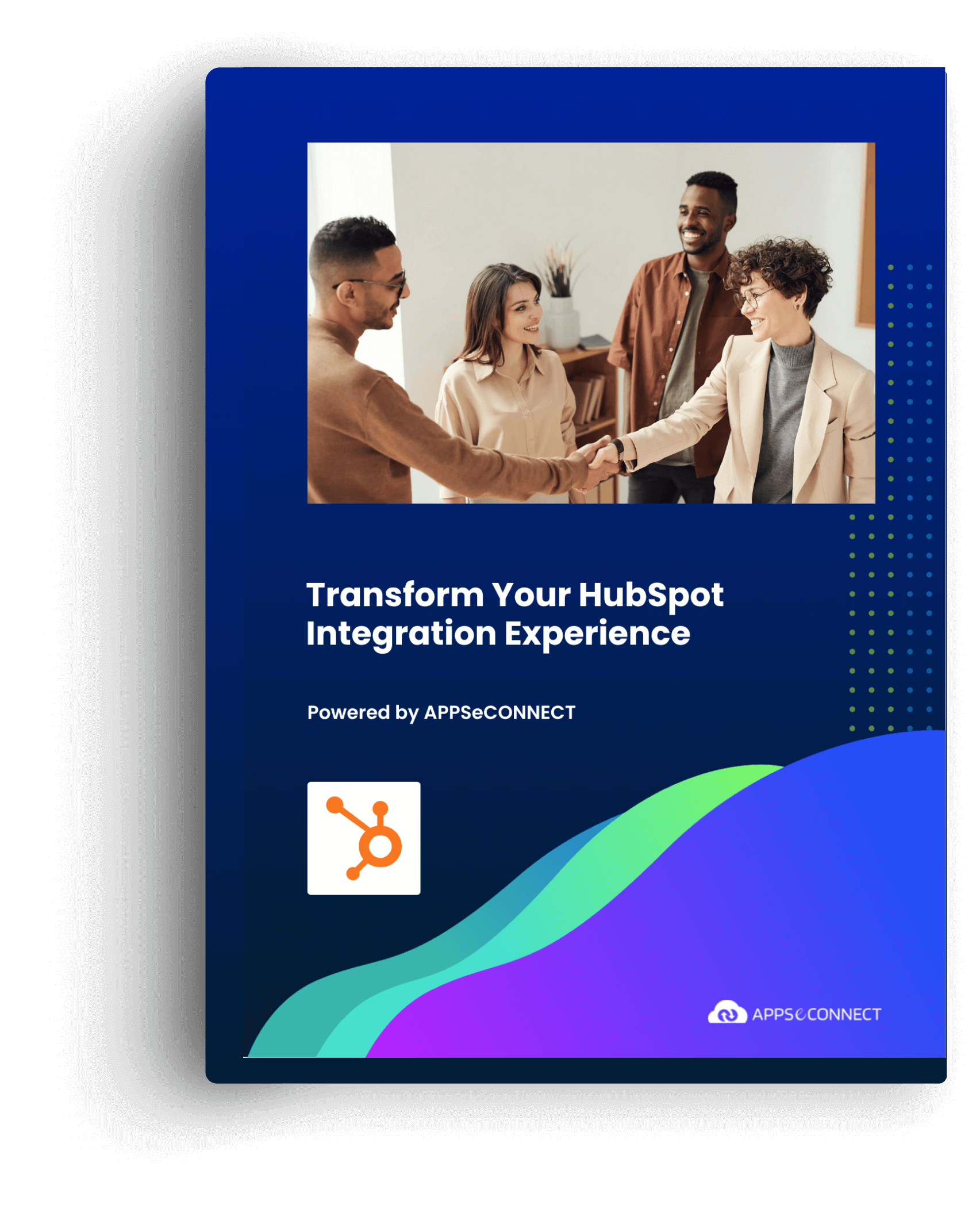
INTEGRATION BROCHURE
Download the HubSpot Integration Brochure
Get the complete reference on how APPSeCONNECT connects HubSpot to your business stack, from architecture to deployment.
Inside You'll Find:
- Integration Architecture: Reference architecture using HubSpot REST APIs and OAuth 2.0, and how contact, company, deal, ticket, and invoice records move with connected applications.
- Sync Coverage: Coverage for contacts, companies, deals, activities, tickets, and invoicing across connected ERP, eCommerce, and support systems.
- Field and Custom-Object Handling: How standard properties, custom fields, and custom objects are mapped so records move with the right context.
- Deployment Roadmap: Prerequisites, timelines, and team responsibilities for rollout.
- Security and Recovery: Authentication model, resync function, and Sync Info dashboard reference.
Real-world use cases
Use Cases
APPSeCONNECT’s HubSpot integration is built for sales, marketing, service, and finance teams that need cleaner records across systems. The goal is to reduce manual work and keep HubSpot connected with the rest of the business.
Sales & Revenue Operations
JAR Systems: SAP Business One and HubSpot Automation
JAR Systems uses HubSpot with SAP Business One to support its sales and operations workflow. After moving to APPSeCONNECT, the team reduced manual transfer work across contact, deal, and order records.
- HubSpot deals can reach the ERP without staff copying them again.
- Contact and company records can move between HubSpot and the ERP.
- Deal-stage changes can update order status in connected systems.
- The integration can support more connected systems as the business expands.
Supports sales and revenue teams running HubSpot as the CRM backbone.
What this integration handles
Synced
HubSpot deals into the ERP
Connected
Contact and company records
Updated
Deal-to-order status
Extendable
More connected systems over time
Marketing & Lead Capture
Form and Campaign Data Enters the Workflow Automatically
Marketing teams need leads from forms and campaigns to enter HubSpot and connected systems without manual copying. This integration helps captured data move into structured workflows so teams spend less time reconciling records.
- Form submissions can create HubSpot contacts or tickets automatically.
- Lifecycle stage and lead details can stay connected across systems.
- Duplicate handling can follow configured rules during mapping.
- Custom properties can move where the flow requires them.
Supports marketing operations and demand-generation teams that use HubSpot as the CRM.
What this integration handles
Captured
Form and campaign submissions
Created
Contacts and tickets
Aligned
Lifecycle and lead data
Mapped
Custom property movement
Service & Finance
Support and Billing Records Remain Easier to Trace
Service and finance teams need tickets, invoices, payment references, and account status to stay connected to the HubSpot record, not arrive as disconnected exports.
- Support tickets and activities can move between HubSpot and connected service tools.
- Invoice and payment references can post back to HubSpot where visibility is required.
- Credits, refunds, and adjustments can follow configured finance rules.
- Logs and snapshots can support reconciliation, audit review, and exception handling.
Supports customer service, accounting, and operations teams that need cleaner transaction traceability.
What this integration handles
Matched
Payment and invoice references
Linked
Tickets and activities
Followed
Credits and adjustments
Recoverable
Resynced records
Workflow
How Does the Workflow Run End-to-End?
Our HubSpot integration runs through ProcessFlows. Each ProcessFlow defines the source system, target system, entity, connector action, schema, mapping logic, validation rules, run mode, retry settings, and monitoring path before any record moves.
Event Capture
A new contact, deal update, or form submission enters HubSpot or a connected channel.
Event Trigger and Source Connection
APPSeCONNECT receives a webhook or scheduled pull, validates the payload, and routes it through your ProcessFlow.
Data Extraction and Schema Reading
The flow reads the selected entity and its schema. The record may be a contact, company, deal, activity, ticket, invoice, payment, or custom object.
Transformation and Field Mapping
Fields transform between HubSpot and the connected system, applying property, custom-object, and validation rules.
Record Creation and Target Push
The connector creates or updates the target record through the relevant API, and captures the response with success state and failure reason.
Back-Sync, Monitoring, and Retry
Return order confirmations, post invoice references, and push status back to HubSpot. Sync Info tracks success and error rates, auto-retry handles transient failures, and missed records can be resynced.
Meet appse ai
How appse ai Helps Streamline HubSpot Integration
A working HubSpot integration reduces manual transfer work, but teams still manage failed records, changing data volumes, repeated checks, and exception review. appse ai adds AI-assisted support for designing workflows, spotting issues earlier, and reducing manual checking across connected processes.
Workflow Design
Help teams describe a process and shape the workflow structure around it, especially when new HubSpot objects or connected systems are added.
Issue Detection
Spot broken flows, error patterns, and records that need review before they become daily cleanup work.
Deal and Order Tracking
Review movement from the first HubSpot record through later updates across connected systems.
Data and Finance Clarity
Make contact, deal, invoice, and payment-related updates easier to review across connected systems.
API Coordination
Support workflows where HubSpot and other systems share data through managed APIs.
Teams Stay in Control
AI-assisted support helps the process while teams set the rules and decide how records move.
Frequently Asked Questions
HubSpot integration connects HubSpot CRM with other business systems through controlled data workflows. APPSeCONNECT can move contacts, companies, deals, activities, tickets, invoices, payments, and custom objects between HubSpot and connected ERP, eCommerce, marketplace, and support systems.
Businesses integrate HubSpot to reduce manual entry and keep CRM records aligned with connected systems. It helps limit duplicate records, delayed order processing, data mismatches, and finance follow-up work, while each system stays responsible for the records it owns.
HubSpot integration can support contacts, companies, deals, activities, tickets, custom properties, custom objects, invoices, payments, credits, and status updates. The final scope depends on the HubSpot setup and the connected application.
APPSeCONNECT connects HubSpot through HubSpot REST APIs with OAuth 2.0. Each ProcessFlow defines the source app, target app, entity, connector action, field mapping, validation rules, run mode, retry behavior, and monitoring path.
HubSpot integration can support two-way sync where the workflow requires it, so records updated in HubSpot and in the connected system can stay aligned. Sync direction is configured per entity during mapping.
A HubSpot connector is a prebuilt link between HubSpot and a specific application, configured through mapping and rules. HubSpot API integration uses REST web services and token-based authentication to move data programmatically. APPSeCONNECT uses both: prebuilt connectors on top of HubSpot REST APIs and OAuth 2.0.
HubSpot can connect with ERP and eCommerce platforms through configured flows. Contacts, companies, deals, orders, invoices, and fulfillment updates can be mapped based on the CRM workflow and the connected system’s process.
HubSpot integration can handle custom HubSpot properties and custom objects through the right integration setup. Custom mappings, validation rules, run modes, and connector actions can be planned around the required HubSpot process.
When a sync fails, APPSeCONNECT provides logs, snapshots, node status, and API responses through the Sync Info dashboard. Auto-retry handles transient failures, and teams can correct missing fields or mapping issues and resync the affected records.
Start by identifying the records that create the most manual work, such as contact sync, company sync, deal-to-order flow, form capture, and invoice or payment references. APPSeCONNECT can then help map, configure, test, monitor, and scale the integration.
Ready to Launch Your HubSpot Integration Today?
Companies automating their business through APPSeCONNECT
Customer Success Stories
With APPSeCONNECT, Hernon achieved a zero business downtime and levaraged the power of a fully automated and integrated solution to ensure business growth.
Related Resources
Articles and Guides to Help You With Your Integration and Automation Journey