





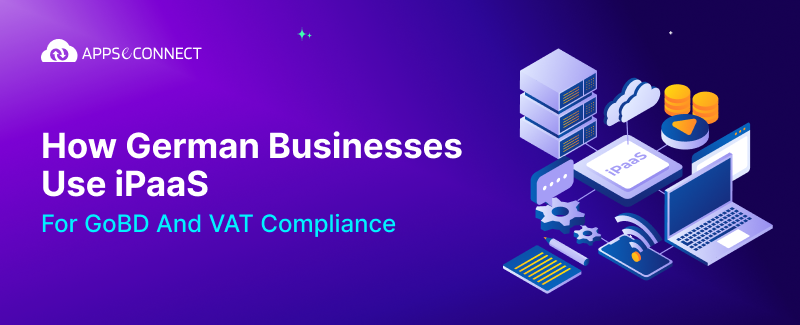
German businesses stay GoBD and VAT compliant by connecting their ERP, accounting, eCommerce, and CRM systems through an Integration Platform as a Service (iPaaS). The platform moves financial data between systems automatically, logs every change, keeps VAT values consistent, and preserves the audit trail that German tax auditors expect to see.
German tax law sets a high bar for how financial records are created, stored, and shared. GoBD defines how digital bookkeeping must work, and VAT rules define how tax must be calculated, invoiced, and reported. Both depend on something many finance teams overlook: the quality of the data flowing between business systems.
When invoices are created in one platform, orders in another, and bookings in a third, compliance breaks in the gaps between them. This guide explains what GoBD and VAT compliance involve, why disconnected systems put both at risk, and how an iPaaS keeps financial data traceable, consistent, and audit ready from the first transaction to the final filing.
What is GoBD?
GoBD is short for Grundsätze zur ordnungsmäßigen Führung und Aufbewahrung von Büchern, Aufzeichnungen und Unterlagen in elektronischer Form sowie zum Datenzugriff. In plain terms, these are the principles for keeping and storing books, records, and documents in electronic form, and for giving tax authorities access to that data.
The regulation comes from the German Federal Ministry of Finance. It was first published in 2014, replacing the older GDPdU and GoBS rules, and the current version has applied since January 2020. It covers every business that keeps tax relevant records in digital form, from freelancers to large corporations.
Under Section 147 of the German Tax Code (Abgabenordnung), tax relevant records must be retained for six or ten years depending on the document type. Invoices, balance sheets, and inventories fall under the ten year period, while commercial correspondence falls under six. During that time, auditors must be able to trace any transaction from its origin to the final ledger entry without manual reconstruction.
If bookkeeping falls short, Section 162 of the Tax Code allows the tax office to estimate the tax base, and those estimates rarely work in the taxpayer’s favor.
What are the Core Principles of GoBD?
Every accounting setup in Germany, including the systems and integrations around it, is measured against six principles:
- Traceability: every entry must link back to a source document, and the full processing chain must be described in a Verfahrensdokumentation, the written documentation of systems, interfaces, and workflows
- Completeness: every transaction is recorded, with document numbers, dates, amounts, and both parties
- Accuracy: records reflect what actually happened and post to the correct accounts
- Timeliness: cash transactions are recorded daily and cashless transactions within ten days
- Orderliness: records are organized so an auditor can find their way quickly
- Unalterability: once posted, a record cannot be overwritten; changes must be logged and versioned
These principles apply to the entire data flow, not just the accounting software. If an integration script silently rewrites an invoice value on its way from the webshop to the ERP, the unalterability principle is broken even though each individual system behaved correctly.
What Does VAT Compliance Require in Germany?
VAT, or Umsatzsteuer, adds a second layer of obligations. Germany applies a standard rate of 19 percent and a reduced rate of 7 percent. Returns are filed electronically through the ELSTER portal, with advance VAT returns (Umsatzsteuer-Voranmeldung) due monthly or quarterly depending on turnover, plus an annual return.
To stay compliant, businesses need to get four things right, every period:
- Correct VAT calculation for each product, customer location, and tax scenario, including reverse charge transactions and One Stop Shop reporting for cross border consumer sales
- Compliant invoices carrying the VAT ID, tax rate, net and gross amounts, and sequential invoice numbers
- Matching figures across the webshop, the ERP, the accounting system, and the filed return
- Filings submitted on time, with no last minute manual consolidation
The common failure point is not the tax logic itself. It is data moving between systems with delays, manual edits, or format mismatches that leave the invoice saying one thing and the VAT return saying another.
Why Do Disconnected Systems Put Compliance at Risk?
Fragmented data across ERP, accounting, and eCommerce
Most companies run separate systems for sales channels, order management, invoicing, and bookkeeping. Without integration, the same transaction exists in several versions: duplicate entries, missing references, and VAT values that no longer match. Proving completeness and accuracy during a GoBD audit becomes slow, manual work.
Broken audit trails
Manual corrections, spreadsheet imports, and offline adjustments interrupt the chain between source document and ledger entry. When nobody can show who changed what, when, and why, audits take longer and scrutiny increases.
Manual VAT handling in complex scenarios
Cross border sales, multiple channels, and mixed tax rates multiply the room for error. Hand maintained tax rules drift out of sync between systems, which leads to under reporting or over reporting.
Month end pressure and late filings
When VAT data has to be consolidated by hand before each filing, finance teams work reactively. Deadlines get tight, corrections pile up, and every late or amended filing draws attention.
Processes that do not scale
Manual checks and custom scripts might hold up at low volume. Add a marketplace, a new legal entity, or a second warehouse, and compliance work grows faster than the team handling it.
How Does iPaaS Support GoBD and VAT Compliance?
An Integration Platform as a Service replaces point to point scripts and manual exports with managed, logged data flows. Transactional data is created once in the source system, then distributed automatically to every downstream system. Each movement is timestamped, validated, and preserved in its original form. Here is what that looks like in practice with APPSeCONNECT.
Automated data synchronization
Order, invoice, customer, and tax data sync between ERP, accounting, invoicing, and eCommerce platforms in near real time, whether the ERP is SAP Business One, SAP S/4HANA, or Microsoft Dynamics 365 Business Central. VAT relevant fields such as tax codes, invoice values, and timestamps stay complete and consistent everywhere, which removes the re-keying step where most errors start.
Audit trails built into every data flow
The platform logs every integration event, including creations, updates, failures, and retries. Auditors can follow a transaction step by step across systems without asking the finance team to reconstruct it, which is exactly what the traceability principle demands.
One set of VAT logic for all systems
Tax codes and calculation rules are standardized in the integration layer before data moves. Invoices, ledger entries, and VAT reports all reflect the same treatment, so reconciliation stops being a monthly firefight.
Centralized monitoring and exception handling
Data flows are monitored from a single dashboard. A transaction with missing tax data or a failed sync is flagged immediately, so issues are corrected before they reach a filing or an auditor.
Security and auditor access
Data moves over encrypted connections with role based access control, so records stay protected against unauthorized changes. Because GoBD gives auditors defined access modes, direct access (Z1), indirect access (Z2), and data carrier transfer (Z3), integrated records must remain exportable in machine readable formats throughout the retention period. Structured, logged integration makes that a default rather than a scramble.
How Does the E-Invoicing Mandate Change Compliance in Germany?
Since January 2025, businesses in Germany must be able to receive structured electronic invoices for domestic B2B transactions, and the obligation to issue them phases in over the following years. Accepted formats include XRechnung and ZUGFeRD, and invoices increasingly travel over the Peppol network. A PDF attached to an email no longer counts as an electronic invoice under the new rules.
This moves compliance even further into integration territory. Every system that creates, receives, or archives invoices has to handle structured invoice data without breaking the GoBD audit trail, from the eCommerce checkout to the ERP to DATEV based workflows with the tax advisor. An iPaaS validates and routes structured formats between systems, keeps the original document alongside its processing log, and holds VAT fields consistent from issuance to archiving.
Businesses that treat e-invoicing as a standalone finance project usually end up rebuilding the same data flows a second time. Treating it as an integration project from the start avoids that.
Example: How a German Manufacturer Automated GoBD Compliance
Consider a mid sized manufacturer selling through B2B invoicing, distributor orders, and a direct webshop. Before integration, VAT was calculated in different systems, invoice formats varied by channel, and month end meant manual adjustments that broke the audit trail.
After connecting the ERP, invoicing platform, and accounting system through APPSeCONNECT, every transaction is captured once, validated automatically, and distributed with full logging. VAT values match across invoices and reports, audit trails stay intact, and audit preparation no longer requires reconstructing data by hand. Compliance became a property of the process instead of a recurring project.
What Are the Benefits Beyond Compliance?
The same integration work that satisfies auditors also pays off in daily operations:
- Less manual effort: invoice entry, reconciliation, and VAT report preparation run automatically, freeing the finance team for real analysis
- A single source of truth: customer records, invoices, stock levels, and tax data match across systems, which improves forecasting and reporting
- Faster financial close: transactions and audit ready records flow continuously instead of being consolidated at month end
- Better visibility: orders, payments, and VAT positions are visible in one place
- Lower long term cost: standardized integrations replace one off scripts, external fixes, and repeated rework
What Comes Next for Digital Compliance in Germany?
The direction is clear: more structured data, more automation, and closer digital contact with the tax authorities. E-invoicing obligations continue to phase in, real time reporting requirements are under discussion across the EU, and regulators increasingly expect businesses to demonstrate control over their data flows, not just their ledgers.
That changes how compliance tooling gets chosen. Rather than adding a separate tool for each new requirement, businesses are embedding compliance logic in the integration layer itself, so a new mandate becomes a configuration change rather than a rebuild. The same pattern already works internationally: APPSeCONNECT supports ZATCA e-invoicing in Saudi Arabia and IRAS e-filing in Singapore using the same integration led approach, which matters for German companies operating across borders.
Final Thoughts
GoBD and VAT compliance in Germany come down to one question: can you show an unbroken, tamper proof record of every transaction across every system it touched? Manual processes and fragmented software make that hard to answer. An iPaaS makes it the default.
APPSeCONNECT connects ERP, eCommerce, CRM, and accounting systems with automated, logged, and monitored data flows, so German businesses can keep books that stand up to an audit while spending less time on compliance work.
Book a free demo to see how automated, audit ready integration would work with your systems.
Frequently Asked Questions
GoBD compliance means keeping digital financial records that are complete, accurate, traceable, timely, orderly, and unalterable throughout the statutory retention period of six or ten years, and being able to give tax auditors structured access to that data.
Yes. GoBD applies to every taxpayer that keeps tax relevant records in electronic form, regardless of company size. The responsibility stays with the taxpayer even when bookkeeping is outsourced to a tax advisor.
An iPaaS automates data exchange between ERP, accounting, CRM, and eCommerce systems while logging every event. Transactions stay traceable and unaltered as they move between systems, which covers the requirements that are hardest to meet with manual processes.
An iPaaS does not replace the tax engine in your ERP or accounting system. What it does is keep VAT logic, tax codes, and invoice data consistent across all connected systems, so a calculation made in one system is not distorted on its way to another.
The tax office can reject the bookkeeping and estimate the tax base under Section 162 of the German Tax Code. That typically means back payments, interest, and longer audits. Serious cases can also lead to investigations under criminal law.
Yes. Structured e-invoices in XRechnung or ZUGFeRD format fall fully under GoBD retention and unalterability rules. Businesses need to receive, process, and archive them without breaking the audit trail, which makes integration between invoicing, ERP, and archiving systems essential.
Ten years for invoices, balance sheets, inventories, and accounting records, and six years for commercial correspondence. The retention period starts at the end of the calendar year in which the document was created.