





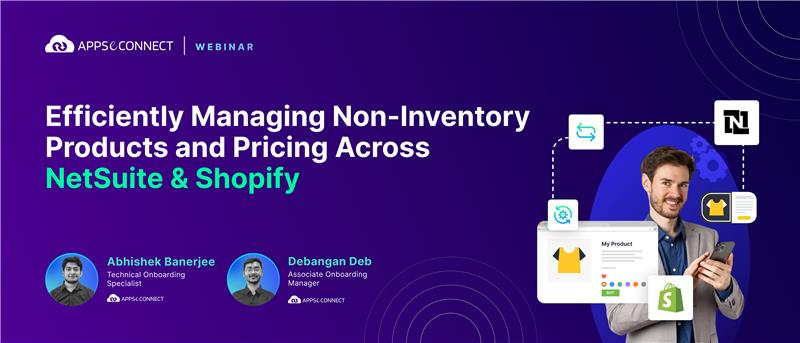
Non-inventory products such as gift cards, services, subscriptions, and digital downloads can be synced from NetSuite to Shopify by matching each NetSuite item record to a Shopify product or variant through a shared SKU, then letting NetSuite own the pricing that Shopify displays. When that mapping is clean, the price a buyer sees at checkout is the same price NetSuite puts on the invoice.
This page recaps a webinar on that exact workflow. It covers what counts as a non-inventory product, how Shopify variants represent NetSuite items, how variant level pricing works, and how to keep both systems aligned over time. A replay of the full session, including the live demo and audience questions, is available on this page.
What Are Non-Inventory Products?
Non-inventory products are items you sell or invoice without tracking quantity on hand. They appear on orders and invoices like any other product, but nothing gets deducted from stock when they sell.
Common examples include:
- Gift cards. Sold online and redeemed later, with no stock count involved.
- Services. Installation, customization, consultation, training, and extended support.
- Digital products. Downloads, license keys, access links, and digital add-ons.
- Subscriptions. Monthly plans, annual memberships, and recurring service packages.
How Are Non-Inventory Items Categorized?
In day to day operations these items usually fall into three groups. Sales items go directly to customers, such as service plans and warranties. Purchase items come from vendors, such as third party support contracts. Resale items are bought first and sold onward with markup.
Many brands mix all three in one store. A shop might sell its own installation service as an add-on while also reselling a vendor warranty plan. In both cases, accurate pricing and invoicing matter more than stock.
Within NetSuite, non-inventory item records sit alongside other item types such as kit items, item groups, and matrix items. Knowing which item type a product uses matters, because sync behavior and Shopify representation differ by type.
Why Should Shopify Prices Match NetSuite Invoices?
Price is one of the first things a buyer checks, and a mismatch between the storefront and the invoice erodes trust quickly. The customer sees one amount at checkout, then a different amount on the bill, and the next step is usually a support ticket or a refund request.
Mismatches tend to come from a handful of causes:
- A price changes in NetSuite but Shopify is not updated
- A promotion runs in Shopify while NetSuite bills under a different rule
- Wholesale price levels exist in NetSuite while Shopify shows retail pricing
- Variant pricing differs by option but the mapping is incomplete
Unified pricing solves this by keeping one pricing logic, maintained in NetSuite, and reflecting it in Shopify so the storefront always shows what NetSuite will bill. For a deeper look at why the two systems price things differently in the first place, see the companion article on the pricing puzzle between NetSuite and Shopify.
How Do Shopify Variants Represent NetSuite Items?
The two platforms structure products differently, and that difference is where most non-inventory sync problems start.
Shopify: One Parent Product with Variants
Shopify groups options such as size, tier, or duration into variants under a single parent listing. Products support up to three option types, and Shopify has announced support for as many as 2,048 variants per product on its updated product model, which gives catalogs far more room than before.
The webinar walked through a product with two options: size, ranging from small to extra large, and glass type, covering standard clear, clear acrylic, non-reflective, and ultra view. Small, medium, and large each carried several glass type variants while extra large had just one. Shopify allows selective combinations, so a store can offer only the mixes that make sense.
NetSuite: Each Item as Its Own Record
NetSuite typically keeps each sellable item as a separate non-inventory item record tied to a SKU and its pricing rules. An attribute like glass type may not exist as a field in NetSuite at all. Shopify can still present that detail through variant setup, as long as the SKU identity and pricing logic carry through the mapping.
The goal is simple. Shopify shows one clean product with variants, and NetSuite keeps reliable item records for billing and reporting.

How Does Variant Level Pricing Work?
Each option combination can carry its own price point. In the webinar example, every size had its own base price and each glass type added its own difference on top, while the extra large size was a single fixed price variant.
Taxes sit on top of the product price and follow the store tax configuration. Invoices stay consistent when NetSuite applies the same tax treatment through item rules and the customer location setup. Pricing precision at the variant level matters because that is exactly where the buyer makes the final choice.
How Do Non-Inventory Orders Reach NetSuite?
Product and price sync is only half the picture. The order itself has to land correctly. When a buyer checks out in Shopify, the integration creates a matching transaction in NetSuite, either a sales order or a cash sale depending on how payment is captured. Line items match by SKU to the corresponding non-inventory item records, the customer record is found or created by email, and payment details carry over for reconciliation.
Because these items skip stock deduction, the flow is simpler than it is for physical goods, but the mapping still has to be exact. A service add-on without a matching NetSuite item will fail the sync, and an unmapped payment method can hold up the entire order. When the flow is right, the invoice, the revenue report, and the storefront all tell the same story.
What Is the Right Sync Schedule for Products and Pricing?
Sync timing decides how fresh the storefront data is. Real time sync pushes a change the moment it happens, usually through webhooks, so a price update in NetSuite reaches Shopify within moments. Scheduled sync runs in batches at set intervals, which suits bulk catalog updates and keeps large runs within API rate limits.
A practical middle ground works for most teams: real time for price and availability changes on active products, and a nightly batch for new item creation, descriptions, and other catalog fields that change less often. Stores with frequent wholesale price updates need tighter intervals than stores with a stable services catalog.
How Do You Keep Product Data Aligned?
Clean alignment prevents pricing disputes, duplicate listings, and broken sync runs. It also makes long term maintenance far easier.
SKU Mapping and Naming Rules
- Keep a one to one SKU relationship between NetSuite and Shopify for every synced item, including services and digital items
- Use a stable SKU format and apply it the same way in both systems
- Keep variant SKUs consistent and readable so support and finance teams can trace them during audits, refunds, and invoice checks
Tax and Fulfillment Settings
Confirm that each item is set as taxable or non-taxable in line with how it should be sold, and that regional rules match on both sides. Set fulfillment behavior that fits the item type, since a service, a download, and a shipped product each behave differently. If you sell in more than one market, check multi-currency handling too, so converted storefront prices match what NetSuite bills.
Who Should Own Pricing?
Keep pricing master data in NetSuite so invoices and finance reporting stay consistent, then sync it outward so Shopify shows the same value NetSuite will invoice. Keep discount logic aligned as well, otherwise a discounted checkout can turn into a full price invoice.
How Do You Prevent Duplicate Products?
Duplicates create reporting noise and confuse buyers. A reliable control pattern has three parts: check for a SKU match before creating anything new, store the Shopify product and variant IDs back in NetSuite using custom fields, and use those stored IDs on later runs to update the same record instead of creating another one.
What About Wholesale Pricing and Shopify Plus?
NetSuite price levels deserve their own attention. Retail, wholesale, and customer specific levels can all live on one item record, and quantity based tiers add another layer. Decide which price level feeds the storefront before you turn on sync.
Brands running business buyers through Shopify Plus can map wholesale price levels to the right customer groups or catalogs so those buyers see contract pricing instead of retail. The Shopify Plus NetSuite integration page covers that setup in more detail, and the NetSuite B2B integration guide walks through the wider wholesale workflow.
How Do You Monitor Sync Health?
Even a well mapped connection hits occasional snags: an item missing a SKU, a price level that was deactivated, a timeout during a large batch. Reliable setups share three habits. Sync logs show exactly which record failed and why. Automatic retries clear transient failures without anyone stepping in. Alerts reach the team before a customer notices a wrong price.
A short weekly reconciliation, comparing a sample of Shopify prices against NetSuite records, catches drift early and keeps confidence in the data high.
How Does APPSeCONNECT Handle NetSuite and Shopify Sync?
APPSeCONNECT provides a prebuilt Shopify and NetSuite connector that keeps non-inventory products and pricing in step without manual double entry. For the scenario covered in this webinar, the integration supports:
- Non-inventory item sync from NetSuite to Shopify, so services, gift cards, subscriptions, and digital items appear with the correct SKU identity
- Item grouping and variant mapping, so separate NetSuite items present as one Shopify product with variants, matching how buyers browse
- Price sync across items and variants, so Shopify reflects NetSuite pricing rules across sizes, add-ons, and tiers
- Discount and promotion sync, so common discounts flow across without manual replication
- Simpler daily operations, since price changes, catalog updates, and variant adjustments need far less manual editing
The webinar replay on this page includes a demo of the full setup, from item mapping through a live price update, followed by the audience Q&A. The complete Shopify NetSuite integration guide is a good next read if you are planning a rollout.

Frequently Asked Questions
Gift cards, services, subscriptions, warranties, installation add-ons, digital downloads, and reseller services. They still need accurate SKUs and pricing because they appear on orders and invoices.
Yes. Shopify supports up to three option types per product, such as service tier, duration, or add-on type, and each combination can become a sellable variant.
Yes. Pricing maps at the variant level so Shopify shows the correct amount for the chosen combination and the NetSuite invoice matches it.
They arrive as sales orders or cash sales with line items matched by SKU to non-inventory item records. No stock is deducted, but pricing, tax, and customer data carry over so the invoice matches the storefront.
Match on SKU before creating anything, store Shopify IDs back in NetSuite in custom fields, and update by stored ID on later runs instead of creating new records.
Keep pricing in NetSuite so invoices and finance reporting stay consistent, and sync it to Shopify so customers see the same amounts NetSuite will bill.