





Boomi vs Workato is a choice between two mature integration platforms that solve the same problem in different ways. Boomi is a broad, enterprise-grade integration platform as a service (iPaaS) built around data integration, API management, and hybrid deployment. Workato is an automation-led iPaaS known for its recipe-based workflow builder and business-user accessibility. If you are evaluating the two, the right answer depends on what you are integrating, who will build and maintain the work, and the total cost over three years rather than the first invoice. This breakdown compares both platforms on capability, pricing, and use-case fit, and shows where an ERP-first option like APPSeCONNECT belongs in the shortlist.
The iPaaS market grew 23.4% to $8.5 billion in 2024 – Gartner, “Market Share Analysis: Integration Platform as a Service, Worldwide, 2024“
Key takeaways
|
Boomi at a glance
Boomi (formerly Dell Boomi)is one of the longest-established iPaaS platforms. Its core is a cloud-native integration engine, historically branded AtomSphere, paired with API management, master data management (MDM), and B2B/EDI capabilities. Boomi is built for IT and integration teams that need to connect cloud and on-premise systems under central governance.
Its strengths are breadth and control. Boomi supports a wide range of deployment models, including hybrid and on-premise runtimes, which matters for regulated industries and legacy estates. It offers a unified platform spanning application integration, data management, and API lifecycle, which can lower total cost when an organization would otherwise buy several tools. The trade-off is that Boomi typically expects a degree of technical ownership; it rewards teams with integration expertise.
Workato at a glance
Workato is an automation-first iPaaS centered on recipes, its term for the automated workflows that connect applications. It is designed so business technologists and operations teams, not only developers, can build integrations. Workato offers a large connector library across SaaS categories and has invested heavily in AI-assisted automation and orchestration.
Its strengths are speed and accessibility. Teams can stand up cross-application workflows quickly, and the platform suits SaaS-heavy environments where the goal is to automate processes across sales, marketing, finance, and support tools. The trade-off is that automation-led platforms can become harder to govern and forecast at scale, and deep, high-volume data integration or on-premise scenarios may require more planning.
By 2025, 70% of new applications will use low-code or no-code technologies (up from <25% in 2020) – Gartner press release
Boomi vs Workato: Feature comparison
The table below summarizes how the two platforms compare on the criteria buyers raise most often. Capabilities evolve, so confirm specifics with each vendor during evaluation.
Criteria | Boomi | Workato |
Primary orientation | Data integration, API management, governed enterprise iPaaS | Workflow automation across SaaS apps (recipes) |
Primary builder | IT / integration specialists | Business technologists and developers |
Deployment | Cloud, hybrid, and on-premise runtimes | Cloud-first |
Connector approach | Broad connector set plus configurable connectors | Large library of app connectors |
API & data management | API lifecycle management and MDM available | Automation-focused; lighter native MDM |
EDI / B2B | Native EDI/B2B support | More limited EDI focus |
AI capabilities | AI-assisted features across the platform | Strong push into AI-led automation/orchestration |
Best-fit buyer | Enterprises needing governed, hybrid, data-heavy integration | SaaS-led teams needing fast automation |
Pricing and total cost of ownership
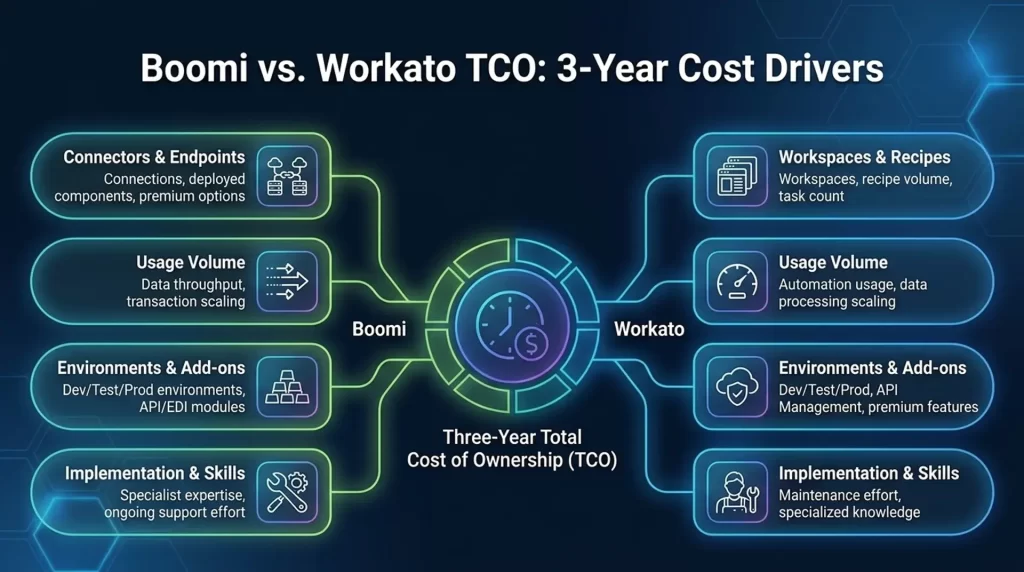
Neither Boomi nor Workato publishes simple, fixed list pricing. Both use quote-based models, and the figure that matters is total cost of ownership (TCO) over the life of the contract, not the first-year license. Treat any specific number you see online as unconfirmed until the vendor quotes your scenario.
Boomi pricing has historically been structured around connections and the components you deploy, with editions that scale by capability and environment. Workato pricing is commonly structured around workspaces and task or recipe volume, with costs that can rise as automation usage grows. In both cases, the cost drivers to model are the same.
- Number of connectors or endpoints, and whether premium connectors carry extra cost.
- Usage volume (tasks, recipes, or data throughput) and how it scales with adoption.
- Environments (development, test, production) and add-ons such as API management or EDI.
- Implementation and maintenance effort, including specialist skills and ongoing support.
A platform with a lower headline price can cost more over three years if usage-based fees climb or if implementation requires scarce expertise. Build a three-year TCO model for each option and ask each vendor to quote against the same integration scope. Poor data quality costs organizations an average of $12.9 million per year – Gartner
Strengths and limitations
Boomi: strengths
- Broad, unified platform covering integration, API management, MDM, and EDI/B2B.
- Flexible deployment, including hybrid and on-premise, for regulated or legacy environments.
- Mature governance and centralized control suited to IT-led integration.
Boomi: limitations
- Generally expects technical ownership; less oriented to business-user self-service.
- Breadth can mean a steeper initial learning curve for smaller teams.
Workato: strengths
- Recipe-based builder that business technologists can use, enabling fast delivery.
- Large SaaS connector library and strong investment in AI-led automation.
- Well suited to automating cross-department processes across cloud applications.
Workato: limitations
- Usage-based costs can be harder to forecast as automation scales.
- Lighter fit for deep on-premise data integration and EDI-heavy B2B scenarios.
Use-case fit: Which platform suits which job
Order-to-cash and ecommerce
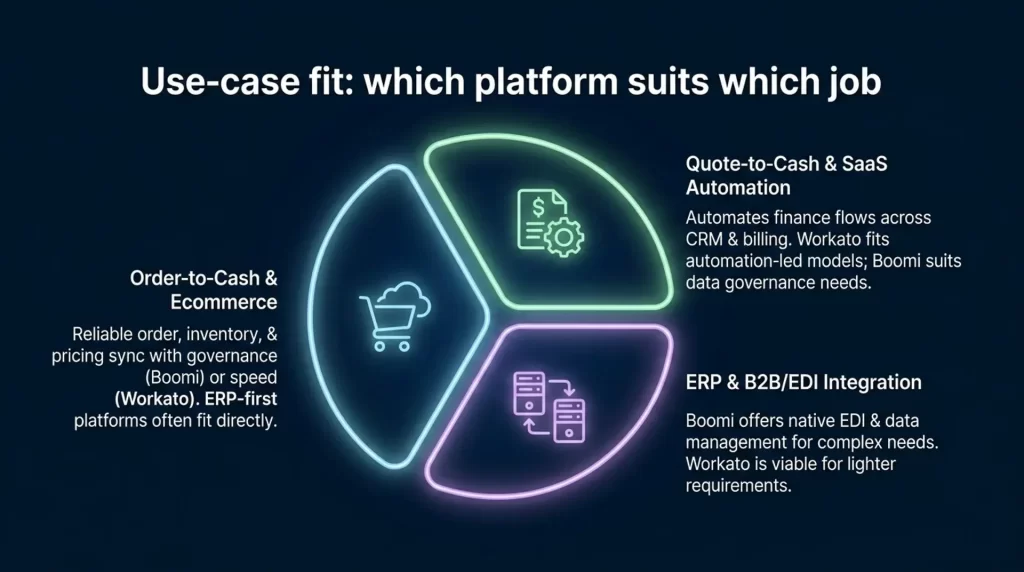
For order-to-cash across an ERP and one or more ecommerce stores, the priorities are reliable order, inventory, customer, and pricing sync, plus error handling when a system rejects a record. Boomi can deliver this with strong governance; Workato can deliver it quickly where the systems are SaaS. An ERP-first platform is often the most direct fit here because the workflows are pre-modeled around the ERP.
Quote-to-cash and SaaS automation
For quote-to-cash and finance automation that spans CRM, CPQ, billing, and support tools, Workato’s automation-led model is a natural fit. Boomi suits the same flows when data governance, API management, or hybrid connectivity are central requirements.
ERP and B2B/EDI integration
For ERP-centric integration with EDI or B2B trading partners, Boomi’s native EDI/B2B and data management are advantages. Workato is viable for lighter EDI needs but is less specialized there.
When Boomi wins, when Workato wins
Choose Boomi when integration is IT-owned and data-heavy, when you need API lifecycle management or MDM, when deployment must be hybrid or on-premise, or when EDI/B2B is core. Boomi rewards organizations that have, or are willing to build, integration expertise.
Choose Workato when speed and business-user enablement matter most, when the landscape is SaaS-heavy, and when the goal is to automate cross-application processes without a large developer effort. Workato shines for automation-led teams that prioritize time to value.
Where APPSeCONNECT fits
Many buyers comparing Boomi and Workato are mid-market companies whose integration revolves around an ERP connected to ecommerce, CRM, and marketplace systems. For that profile, an ERP-first iPaaS is worth shortlisting alongside the two. APPSeCONNECT is an ERP-first integration platform built for exactly this scenario: bi-directional sync of orders, inventory, customers, items, and pricing between ERPs and ecommerce or CRM systems, with pre-built connectors and workflow templates that shorten implementation.
The evaluation criteria are the same ones you would apply to Boomi or Workato. Does the platform connect your specific ERP and storefronts out of the box? Is pricing predictable as volume grows? How much specialist effort does implementation and maintenance require? What is the support model? APPSeCONNECT is positioned on predictable, scalable cost and ERP-centric pre-built integration, with a security posture covering ISO 27001 and GDPR. The right choice is the platform whose strengths match your integration profile and budget, evaluated against a like-for-like scope.
How to choose: A short evaluation checklist
- Map your integration scope: which systems, which direction, and what data volume.
- Decide who owns integration: IT specialists, business technologists, or a vendor-supported model.
- Confirm deployment needs: cloud-only, hybrid, or on-premise, and any compliance constraints.
- List required capabilities: API management, MDM, EDI/B2B, AI-assisted automation.
- Build a three-year TCO model and request like-for-like quotes from each vendor.
- Run a proof of concept on your highest-value workflow before committing.
Frequently Asked Questions
Neither is universally better. Boomi is stronger for governed, data-heavy enterprise integration, API management, hybrid deployment, and EDI/B2B. Workato is stronger for fast, business-led automation across SaaS applications. The better platform is the one whose strengths match your integration scope, your team, and your deployment needs.
Boomi is oriented around data integration, API lifecycle management, and governed enterprise iPaaS with flexible deployment. Workato is oriented around recipe-based workflow automation that business technologists can build. In short, Boomi emphasizes integration and governance; Workato emphasizes automation and speed.
Both use quote-based pricing rather than fixed public list prices. Boomi cost is commonly tied to connections, components, and editions; Workato cost is commonly tied to workspaces and task or recipe volume. Always model three-year total cost of ownership and request a quote against your specific scope.
Workato is generally considered more accessible to non-developers because of its recipe builder. Boomi is powerful but typically expects more technical ownership. Ease of use depends on who will build and maintain your integrations.
Boomi offers native EDI/B2B capabilities and is well suited to trading-partner integration. Workato can handle lighter EDI needs but is less specialized in that area. If EDI is core to your operation, weigh Boomi or a platform with dedicated EDI support.
Both connect to major ERPs through connectors, though depth and configuration effort vary by system. For ERP-centric integration with ecommerce and CRM, an ERP-first platform with pre-built ERP workflows can reduce implementation time.
For ecommerce connected to an ERP, the priority is reliable order, inventory, and pricing sync with strong error handling. Both can do it; an ERP-first iPaaS is often the most direct fit because the workflows are pre-modeled around the ERP and storefront.
MuleSoft is a heavier, API-led enterprise platform often chosen for complex, developer-driven integration. Boomi competes on breadth and governance with flexible deployment; Workato competes on automation speed and business-user enablement. The right fit again depends on scope and team.
Watch for premium connector fees, usage-based charges that scale with adoption, costs for additional environments, add-ons such as API management or EDI, and implementation and maintenance effort. These often outweigh the headline license in a three-year view.
Yes. The iPaaS market includes several platforms positioned for different profiles. Mid-market companies whose integration centers on an ERP plus ecommerce and CRM should also evaluate ERP-first platforms such as APPSeCONNECT, judged on the same criteria of fit, cost predictability, and support.
It depends on the number of systems, data complexity, and available expertise. SaaS-only automation can go live quickly; governed, data-heavy, or hybrid integration takes longer. Pre-built connectors and templates shorten timelines, so factor them into your comparison.
A small team usually benefits from a platform with pre-built workflows and strong vendor support, because it reduces the specialist effort required. Evaluate how much you will build yourself versus rely on connectors, templates, and the vendor.
Conclusion and next steps
Boomi vs Workato is not a contest for a single winner. Boomi is the stronger choice for governed, data-heavy, hybrid enterprise integration with API management and EDI. Workato is the stronger choice for fast, business-led automation across SaaS applications. Decide by mapping your integration scope, your team, your deployment constraints, and your three-year total cost of ownership, then validate with a proof of concept on your most important workflow.
If your integration centers on an ERP connected to ecommerce, CRM, and marketplaces, add an ERP-first platform such as APPSeCONNECT to the shortlist and compare it on the same criteria. Book a demo to see how ERP-first, pre-built integration maps to your systems, or explore the connector library to confirm coverage for your stack.