





Yes, SAP Business One is one of the most suitable ERP systems for eCommerce businesses. It runs finance, inventory, purchasing, and order management on a single database, and it connects to eCommerce platforms, marketplaces, and CRMs through integration platforms such as APPSeCONNECT, so orders, stock, pricing, and customers stay in sync automatically. For a small or mid-sized business selling online, that combination of a proven ERP core plus real-time integration is what keeps operations accurate as order volume grows.
This guide explains why SAP Business One fits eCommerce, how it compares to NetSuite and Microsoft Dynamics 365 Business Central, what it costs to run alongside a storefront, and how to connect it to the channels you sell on.
Key takeaways
|
Core operations every eCommerce business has to run
Selling online is not just a storefront. Behind every order sits inventory, pricing, fulfilment, invoicing, returns, and customer records, and each has to stay accurate across every channel. When those live in disconnected systems, teams re-key data, stock drifts, and orders slip.
The stakes are large. IHL Group estimates retailers lose about 1.73 trillion dollars a year to inventory distortion, with roughly 1.2 trillion of that from out-of-stocks alone, when a customer is ready to buy but the item is not available. Real-time inventory sync between the ERP and every sales channel is the direct defence, and it is a main reason growing eCommerce businesses move onto an ERP and integrate it.
Why SAP Business One is a strong ERP for eCommerce
SAP Business One is built for the small and mid-sized businesses that make up most of eCommerce, and it covers the operational core those businesses need to sell online reliably.
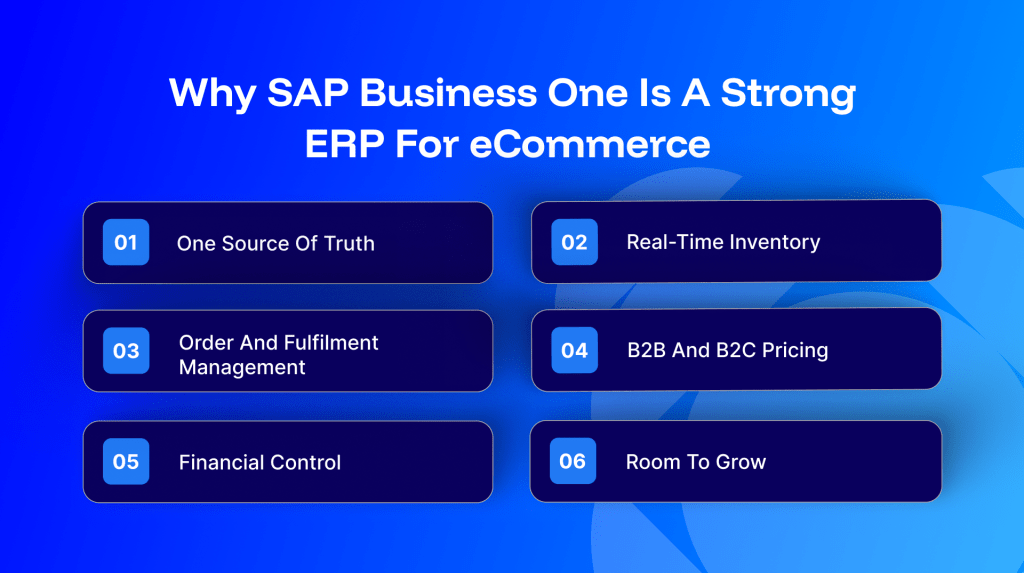
- One source of truth. Finance, inventory, purchasing, and orders share one database, so every team works from the same numbers.
- Real-time inventory. Stock is managed centrally, which, once integrated, prevents the overselling and stockouts that cost retailers most.
- Order and fulfilment management. Sales orders, deliveries, invoices, and returns are handled end to end.
- B2B and B2C pricing. Customer-specific price lists and discounts are supported, which matters for wholesale and mixed models.
- Financial control. Accounting, tax, and multi-currency are native, so online sales reconcile cleanly.
- Room to grow. It scales across warehouses, entities, and channels without moving off the platform.
On their own these are ERP features. What turns them into an eCommerce advantage is integration, covered below.
Is SAP Business One the best ERP for eCommerce?
There is no single best ERP for eCommerce; the right choice depends on business size, complexity, and budget. SAP Business One is a strong fit for small and mid-sized businesses that want a proven, on-premise-or-cloud ERP with deep financial and inventory control and a large partner ecosystem. Larger, cloud-first enterprises often weigh NetSuite; businesses already in the Microsoft stack often weigh Business Central. Use the criteria below, then the comparison, to decide.
- Business size and growth stage (SMB vs enterprise).
- Deployment preference (cloud, on-premise, or hybrid).
- Depth of inventory, manufacturing, and financial needs.
- Existing tech stack and in-house skills.
- Total cost of ownership, including integration and maintenance.
SAP Business One vs NetSuite vs Business Central
The three ERPs most often compared for mid-market eCommerce. This is a neutral, factual summary; evaluate each against your own requirements.
|
Factor |
SAP Business One |
Oracle NetSuite |
Dynamics 365 Business Central |
|
Best fit |
Small and mid-sized businesses |
Cloud-first, fast-scaling mid-market to enterprise |
Businesses in the Microsoft ecosystem |
|
Deployment |
On-premise, cloud, or hybrid |
Cloud only |
Cloud (and hybrid options) |
|
Core strength |
Financial + inventory depth for SMBs |
Native cloud suite breadth |
Tight Microsoft 365 / Dynamics integration |
|
eCommerce approach |
Integrate via iPaaS/connectors |
Integrate via iPaaS/connectors |
Integrate via iPaaS/connectors |
|
Typical consideration |
Wide partner network; flexible deployment |
Subscription cost at scale |
Best when standardised on Microsoft |
Whichever ERP you choose, the eCommerce outcome depends on how well it connects to your storefront and channels. That integration layer is the deciding factor for online sellers.
SAP Business One adoption
SAP Business One is one of the most widely deployed ERPs for small and mid-sized businesses worldwide, backed by SAP and a large global partner and reseller network. That maturity means proven eCommerce integration paths and support are readily available.
Connecting SAP Business One to your eCommerce store
The ERP delivers its eCommerce value when it is integrated. An integration platform such as APPSeCONNECT connects SAP Business One to platforms like Shopify, Magento (Adobe Commerce), WooCommerce, and BigCommerce, and to marketplaces such as Amazon, using prebuilt connectors and a low-code workflow builder. Orders flow from the store into SAP Business One, stock and pricing flow out to every channel, and invoices and shipment status flow back to the customer, in real time and without manual entry.
What makes an integration hold up at scale
Not every integration is equal. Three things separate one that lasts from one that breaks.
- First, ERP-first design where the platform understands SAP Business One’s pricing, tax, and multi-entity structure natively, rather than treating it as a generic endpoint.
- Second, prebuilt connectors and low-code workflows, so you go live in hours rather than months of custom development, and you add a channel by adding a connector, not another brittle script.
- Third, built-in reliability where retries, logging, and monitoring so a failed order surfaces instead of disappearing. APPSeCONNECT is built on these, and handles data to ISO 27001 and GDPR standards.
For the methods, interfaces, and architecture behind that, see the guide on how to connect SAP Business One to eCommerce, or the SAP Business One integration hub for the full list of connectors.
Real results from SAP Business One eCommerce integrations
Outcomes APPSeCONNECT customers reported after connecting SAP Business One to their eCommerce channels.
|
Business |
Store |
Reported result |
|
Shopify Plus |
Synced 99% of bulk orders automatically – and held 99% even through Black Friday peak volume |
|
|
WooCommerce |
30% increase in sales volume, with no additional overhead cost |
|
|
WooCommerce |
Streamlined operations across a large beverage catalogue |
|
|
Shopify Plus |
Automated order and inventory sync across the business |
Across more than 100 SAP Business One integrations, the pattern is consistent: businesses that sync orders and inventory in real time protect their sales during peak periods and scale without adding headcount.
Frequently Asked Questions
Yes. SAP Business One gives an eCommerce business one system for finance, inventory, orders, and customers, and it connects to online stores and marketplaces through an integration platform so data syncs automatically. That combination keeps operations accurate as order volume grows.
There is no single best ERP; it depends on size, complexity, and budget. SAP Business One suits small and mid-sized businesses, NetSuite suits cloud-first scaling companies, and Business Central suits Microsoft-centric businesses. The deciding factor for online sellers is how well the ERP integrates with the storefront and channels.
SAP Business One is often chosen by small and mid-sized businesses wanting flexible deployment and deep SMB financial and inventory control; NetSuite is a cloud-only suite often chosen by faster-scaling mid-market to enterprise businesses. Both integrate with eCommerce via a platform. Choose on business size, deployment, and total cost.
Both are strong mid-market ERPs. Business Central fits businesses standardised on Microsoft 365 and Dynamics; SAP Business One fits businesses wanting a proven SMB ERP with flexible deployment and a large partner network. For eCommerce, both rely on an integration layer to connect to the storefront.
SAP Business One includes built-in CRM functionality for sales, opportunities, and customer management. Many businesses also integrate it with a dedicated CRM such as Salesforce, HubSpot, or Zoho when they need more advanced sales and marketing features.
Microsoft Dynamics 365 Business Central is an ERP. It covers finance, operations, inventory, and sales. Microsoft offers separate Dynamics 365 CRM applications for dedicated customer relationship management.
Through an integration platform with prebuilt connectors, such as APPSeCONNECT. The platform syncs orders, inventory, items, pricing, and customers between SAP Business One and the store or marketplace in real time, without custom code for each connection.
Cost depends on user count, deployment (cloud or on-premise), and add-ons, and is set by SAP and its partners. Budget separately for the integration layer that connects it to your store. Request current pricing from an SAP partner and an integration platform for an accurate figure.
Yes. SAP Business One supports customer-specific pricing, price lists, and discounts, which suits B2B, and standard order and fulfilment flows for B2C. Integrated with the right storefront, it runs both models from one back end.
Common integrations include Shopify and Shopify Plus, Magento (Adobe Commerce), WooCommerce, BigCommerce, and marketplaces such as Amazon and eBay, plus CRMs and shipping tools – typically connected through an integration platform.
Conclusion
SAP Business One is a strong, proven ERP for small and mid-sized eCommerce businesses. It runs the operational core on one system, and, connected to your store and channels through an integration platform, it keeps orders, inventory, and pricing accurate in real time – the difference between capturing peak-season demand and losing it to a stockout. Weigh it against NetSuite and Business Central on size, deployment, and cost, but for most SMBs selling online it is a dependable choice, provided the integration is done well.
Next step
|