




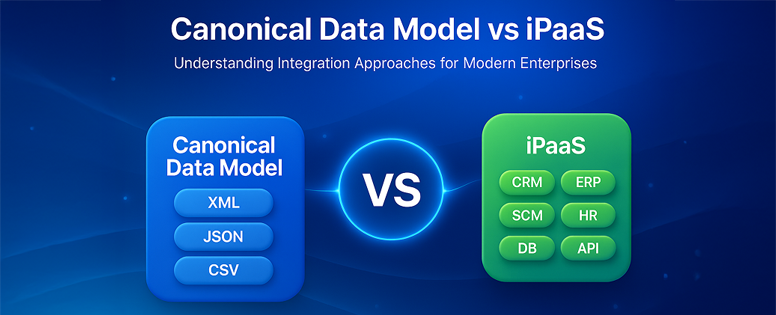
Most enterprises do not have a data problem so much as a connection problem. Information is fragmented across hundreds of applications, and the real question is how to make those systems talk to each other reliably. This guide explains the canonical data model vs iPaaS debate in plain terms: what each approach is, where the canonical model breaks down at scale, and how to choose the right model for your integration strategy. The architecture you pick has direct commercial consequences, so it is worth understanding both sides before you commit.
How Point to Point Integration Created the Need for a Canonical Data Model
To understand the canonical model, start with the problem it was invented to solve. When every application talks directly to every other application, you build point to point integrations, and the connections multiply fast. This tangle is widely known as the integration problem. The math is unforgiving, because connecting systems directly grows very quickly, so ten systems can require up to ninety separate interfaces to maintain. A canonical data model attacks that growth by introducing one shared, neutral format in the middle. Each system maps only to and from the canonical form, which turns those many pairwise mappings into a small set of adapters, closer to two per system. This is the same hub and spoke idea that underpinned Enterprise Application Integration (EAI) era, and it is the foundation of the canonical data model vs iPaaS comparison that follows.
What is a Canonical Data Model?
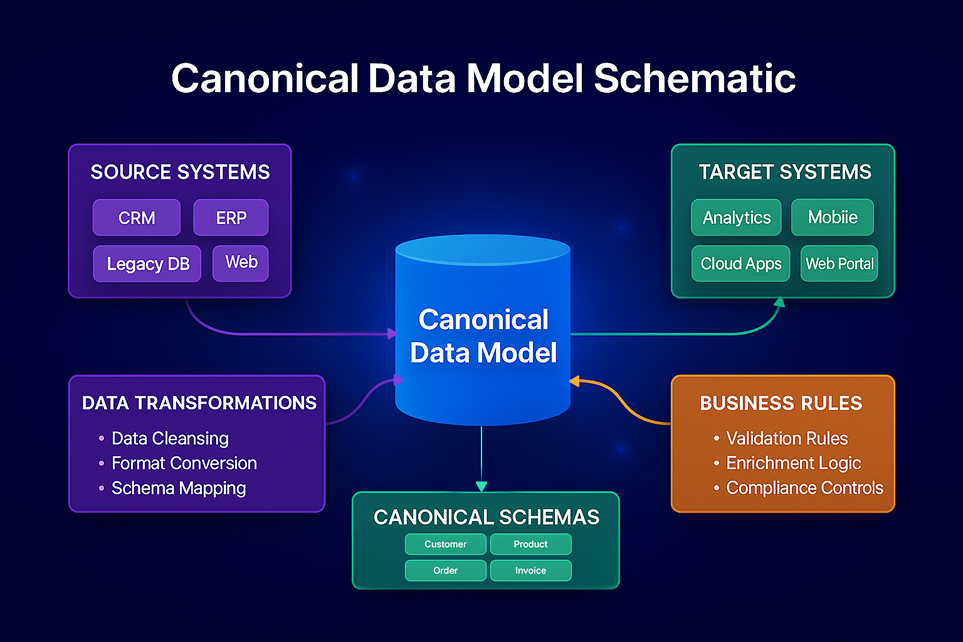
A canonical data model is a type of data model that presents data entities and relationships in their simplest form so that processes can be integrated across systems and databases. It is sometimes called a common data model because it uses one common language to describe data. The purpose is to let an enterprise define and share a single definition of each data unit, which makes data exchange between systems far easier.
In practice, the canonical model defines stable business entities such as Customer, Order, Product and Invoice, then has every system translate to and from those definitions. Rather than letting each application speak its own dialect, the model acts as a neutral intermediary, which improves interoperability and supports loose coupling between systems. The approach can incorporate any technology the enterprise already uses, including Enterprise Service Management, Business Process Management and Service Oriented Architecture. Its benefits include better logic maintenance, better translation maintenance and fewer translations overall. Before committing, though, you need a clear picture of iPaaS and where each model fits.
What is iPaaS?
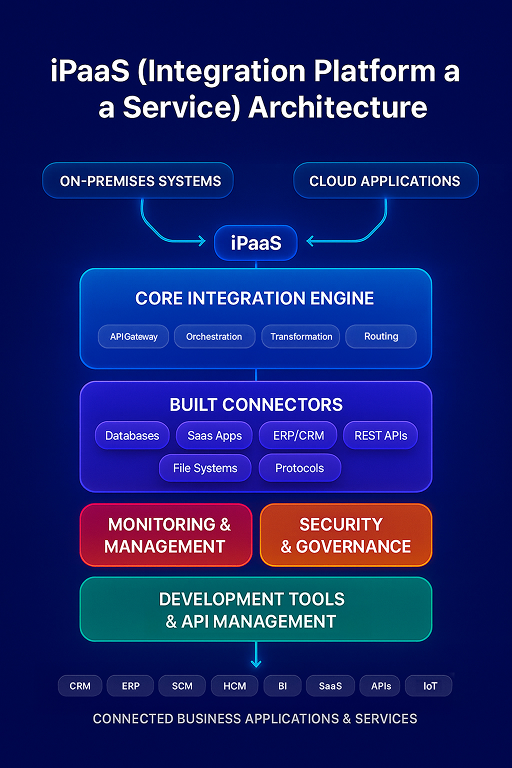
iPaaS provides cloud based tools to connect different applications quickly and securely. It has become a popular integration choice for businesses, and more companies are shifting to iPaaS from older methods. With iPaaS, you can bring systems from different environments onto a single platform and manage them centrally.
Learn more about iPaaS: Book your trial now!
Canonical Data Model vs iPaaS Comparison
Parameter | Canonical Data Model | iPaaS |
Definition | A common data model that is independent of the applications in the environment. | A set of cloud based tools used to integrate data from applications in different environments. |
Primary purpose | Represent data in a standard format across systems. | Integrate different systems onto a single platform. |
Scope | Best for small to mid scale, stable projects. | Built for large scale, fast changing projects. |
Implementation | Needs continuous development to build and maintain. | Comes with ready made templates and connectors. |
Coupling | Reduces coupling but can tie teams to one shared format. | Reusable connectors keep systems loosely coupled. |
Governance | Needs owners, stewards and change control. | Largely handled by the vendor. |
Data formats | You define and maintain the schema in XML, JSON or Avro. | Built in mapping handles many formats out of the box. |
Real time | Often batch based, real time needs extra work. | Supports near real time sync through connectors and events. |
Deployment | Internal teams or consultants. | Hosted in the cloud by a provider. |
Maintenance | Continuous as needs change. | Maintained by the vendor. |
Cost structure | Build and maintenance cost. | Subscription based pricing. |
Time to deploy | Considerably longer. | Short, often days to weeks. |
Why a Single Canonical Data Model Struggles at Scale
A canonical data model can be a sensible choice for small needs, but at enterprise scale the same design tends to work against you. The first problem is scope. To serve every system, the model gathers a large set of optional fields and very few required ones, and it slowly becomes what integration architects call a god model, something that tries to describe everything and therefore becomes slow to change.
The second problem is coupling. The model was meant to reduce dependencies, yet a single company wide format means every team becomes tightly coupled to one shared structure that changes often. A change to the canonical Customer definition can affect the whole landscape. Modern thinking from Domain Driven Design warns against forcing one model across all bounded contexts, because that erases the local meaning each area depends on. The third problem is effort, since building and maintaining mappings, versions and translations by hand takes continuous work that grows with every new system.
When a Canonical Data Model Still Makes Sense
A canonical data model is not obsolete, and treating it as universally wrong would be misleading. It remains a strong pattern when the scope is deliberately narrow and the entities are stable. If you are standardizing a few core entities such as Customer and Order across a controlled SOA or ESB estate, a lean model with a small core can genuinely reduce mapping costs. The keys to success are disciplined governance, clear schema versioning and the willingness to keep the model small. In short, the model fails when it is overbuilt, not because the idea is flawed.
Alternatives to Canonical Data Models in Modern Integration:
Here are some of the alternatives to canonical data model in integration that you can opt for:
Application Programming Interfaces (API) integration:
This method makes use of Application Programming Interfaces (APIs) to allow communication between the systems. The integration is done through standardized interfaces. This form of integration works by linking two different platforms together by following a specific set of protocols. Once integrated, the platforms can send data back and forth through the APIs.
Benefits of API integration:
- Flexibility and reusability.
- Simplified integration process.
- Easier connection between two external services.
- Scalable and adaptable to future needs.
- Enhanced scope of innovation.
Web hooks and event-driven integration:
This integration method is based on systems reacting to events that occur in other systems. This occurs through configured webhooks or event listeners. Unlike the traditional polling approach, webhooks automatically send out information to the systems when certain events have happened.
Benefits of webhook integration:
- Real-time updates based on events.
- Loose coupling between the systems.
- Reduced load by sending data when required.
- Scalable for several events.
Microservices:
Microservices allow for continuous integration and continuous delivery. This makes it easy for companies to try out new ideas and rollback in case something doesn’t work. Microservices are an architectural approach to developing different applications as a small collection of independent services that communicate with each other. The integration is composed of many discrete network-connected components that allow the data to communicate between the systems.
Benefits of microservices:
- Enhanced scalability.
- Improved fault isolation.
- Faster time-to-market.
- Easy deployment.
iPaaS integration:
iPaaS is a cloud-based platform that offers multiple tools and functionalities for building, running, and managing interactions between different systems. It is the easiest and most effective way of integrating complex scenarios.
Benefits of iPaaS:
- Reduced technical complexity.
- Faster speed of implementation.
- Enhanced scalability.
- Pre-configured connections.
- User-friendly interfaces.
- Continuous improvements and upgrades.
Explore the various features of iPaaS -> Talk to the experts now!
Which Method Of Integration Should You Choose? Use Cases and Recommendations
With so many different integration options available to you, you must be confused regarding which exact type of integration you should choose. Well, here we are going to take you through some of the use cases of popular alternatives to canonical data model in integration:
API Integration:
API integration is ideal for companies that are willing to build a future-proof IT infrastructure. It is vital for businesses that are looking forward to integrating cloud services. It is also suitable for companies that wish to offer functionalities to external partners.
Axis Bank, one of the global financial institutes, made use of IBM API Connect to transform the digital banking experience for the customers.
Webhooks:
This is ideal for real-time systems where fast data transfer is required. It is also common in e-commerce systems that require reacting to orders and inventory systems. Iot systems also make use of this integration.
Microservices:
Microservices are used in situations where real-time data processing is required. It is also an ideal choice for applications that deal with big data and AI/ML technology. You can also make use of microservices for refactoring legacy applications.
P.S: Top companies like Netflix, Amazon, and Uber are already using microservices in their environment.
iPaaS integration:
It is particularly suitable for companies that wish to cut IT infrastructure costs. It is ideal for businesses that are looking forward to integrating cloud-based services quickly. It also positions itself to be suitable for companies undergoing rapid digital transformation.
Take a quick demo of our iPaaS
APPSeCONNECT: The iPaaS Provider Trusted by 100+ Brands
APPSeCONNECT is an iPaaS platform for connecting CRM, ERP and ecommerce applications. It offers ready to use connectors, prebuilt templates, workflow automation and ongoing support, and it is designed to be approachable for non technical users while flexible enough for detailed requirements.
Hear What People Have to Say About APPSeCONNECT’s Services:
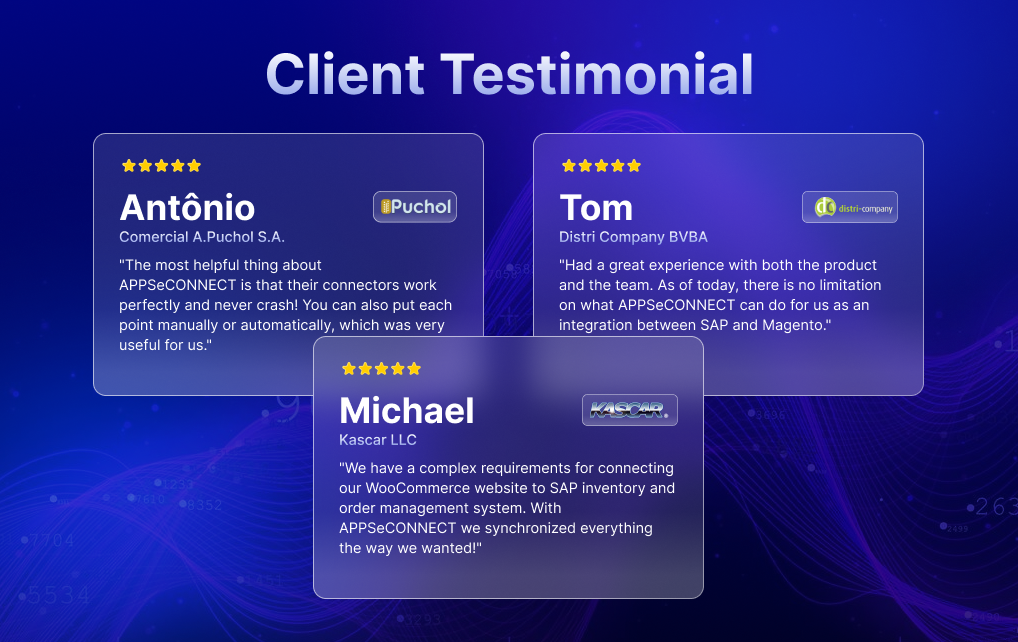
APPSeCONNECT has an overall rating of 4.7 on Capterra, which makes it one of the top alternatives to canonical data model in integration. Here’s what the clients have to say about the company’s services:
Connect Your Apps, Grow Your Business – Contact and book demo Today!
The Future of Enterprise Integration: Things to Watch Out for
Enterprise integration has turned out to be an extremely crucial aspect of modern business operations that deal with diverse applications and data sources. As technology continues to evolve at an unprecedented rate, the landscape of enterprise integration is also experiencing transformative evolution. More people are also becoming aware of the difference between canonical data model and iPaaS.
Over time, we will be able to see multiple advancements in enterprise integration. Among growing trends and innovation, the seamless integration of Iot has emerged as a driving force. It has been reinventing the way organisations communicate with multiple devices. The demand for hybrid integration platforms has also been on the rise in the past few years.
AI/ML-based technologies have also started to gain pace. They can optimize data by allowing seamless communications between diverse platforms and also predict patterns for decision-making. The low-code and no-code platforms are also shaping the future of enterprise integration by democratizing application development. These platforms allow users with different levels of technical expertise to create modern enterprise solutions.
Wrapping Up:
So, are you ready to bring the different applications in your environment onto the same platform? Willing to experience the APPSeCONNECT difference? Well then, you may consider reaching out to the integration experts at APPSeCONNECT and get your journey started today itself.
Explore APPSeCONNECT’s Services -> Book Your Demo Now!