





A SaaS integration strategy defines how cloud applications connect, how data moves between them, and how those workflows stay governed after launch. Connecting two systems is the easy part. The hard part starts when the business adds more applications, more records, more workflow rules, and more pressure on the same connections, and that pressure scales fast given the average company now runs about 106 SaaS applications. A clear strategy is what keeps those connections from turning into recurring operational cleanup.
The core decision is which integration approach fits your stack: native connectors, custom code, iPaaS, or embedded iPaaS. Fit matters more than feature count, because the right approach maps to how many systems you run, how your data needs to move, and how much maintenance your team can realistically carry.
Key Takeaways
|
What Is A SaaS Integration Strategy?
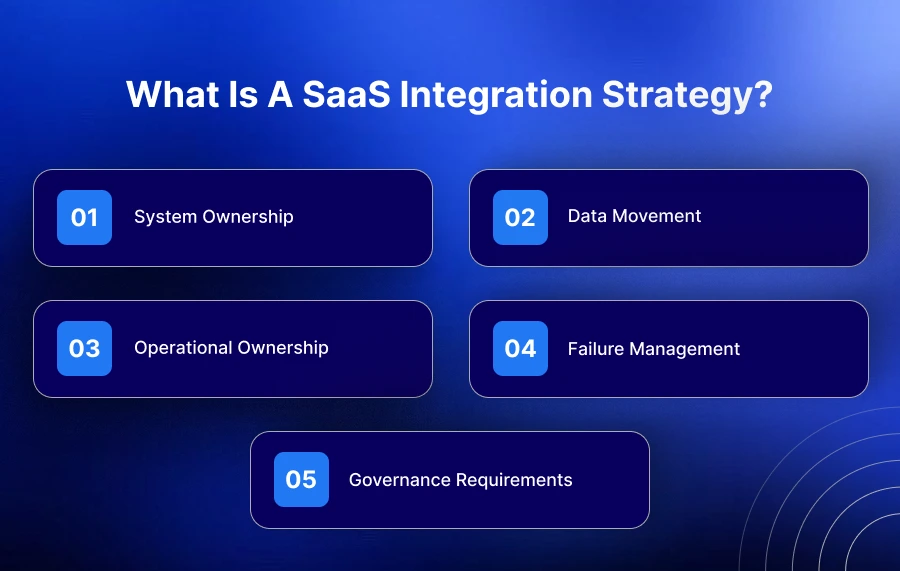
A SaaS integration strategy is a structured plan for connecting cloud applications so the connections stay reliable as the business grows. SaaS integration moves data between cloud applications. A strategy goes further: it defines which systems should connect, what data should move, how often it should sync, and who manages the workflow once it is live.
That distinction matters because integration problems usually appear after launch. A workflow that runs cleanly between two applications can become hard to manage once teams add more systems, custom fields, approval rules, and higher transaction volume.
Concept | Role in the strategy | Buyer impact |
SaaS integration | Connects cloud applications and moves data between them | Reduces manual data entry and disconnected work |
SaaS integration strategy | Defines ownership, governance, monitoring, and long-term maintenance | Keeps integrations reliable as the stack grows |
SaaS integration platform | Gives teams a central system to build and manage integrations | Scales workflows with more control and visibility |
A strong strategy answers a few practical questions before implementation begins:
- System Ownership: Which application owns customer, product, order, invoice, payment, and inventory data?
- Data Movement: Which workflows need real-time updates, and which can run on a schedule?
- Operational Ownership: Who maintains the workflow after launch?
- Failure Management: How will the team detect, review, retry, and resolve failed records?
- Governance Requirements: How will access, permissions, audit trails, and data location be managed?
Why A Deliberate Integration Strategy Matters
SaaS integrations usually become fragile because the business changes around them. A connection built for a clean, limited workflow gets harder to manage as systems, records, business rules, and users pile up. The problem is rarely the integration itself. It is the absence of governance over how the workflow will be maintained.
- API Changes: SaaS vendors update APIs, adjust fields, retire endpoints, and change access requirements. When ownership is unclear, these changes create disruption.
- Access And Token Issues: API keys, OAuth tokens, service accounts, and certificates need regular management. Weak control leads to expired access, over-permissioned accounts, or failed syncs.
- Field-Mapping Issues: Teams customize fields inside SaaS applications. When the meaning of a field changes, incorrect data can move into downstream systems, and poor data quality costs organizations an average of $12.9 million a year.
- Limited Error Visibility: Failed records need to surface early. If errors go unnoticed, teams often discover them through customer issues, stock mismatches, or finance reconciliation.
- Rising Maintenance Cost: Every new connection adds testing, documentation, monitoring, and support. Without a clear model, maintenance grows faster than the team can absorb.
A SaaS integration strategy should reduce these risks before they become recurring operational issues.
Core SaaS Integration Approaches
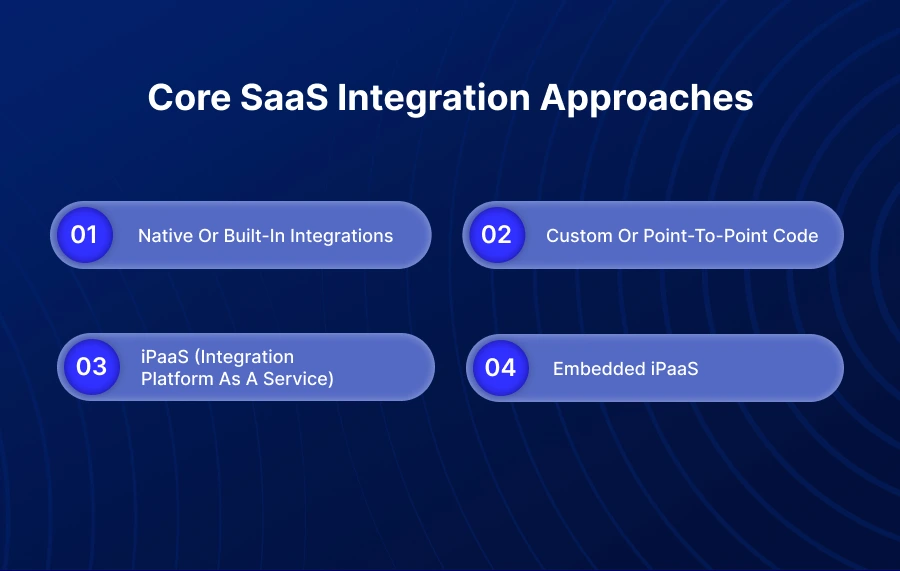
Most SaaS integration strategies use one or more of four approaches: native integrations, custom code, iPaaS, and embedded iPaaS. Each works well in the right context. The decision should turn on durability, visibility, maintenance effort, and the level of control the business needs.
Native Or Built-In Integrations
Native integrations are connections already available inside a SaaS application, and they are often the fastest way to link two common tools for a standard workflow. They work well for simple use cases such as sending leads into a CRM, syncing basic contacts, or pushing activity updates into another application.
The limitation is control. Native integrations may not offer enough flexibility for custom fields, workflow logic, error handling, or detailed monitoring. They are easy to start but may not support more complex requirements as the business grows.
- Best for: Standard SaaS-to-SaaS workflows with limited customization.
- Main strength: Fast setup with minimal technical effort.
- Main risk: Limited flexibility and visibility when workflow complexity increases.
Custom Or Point-To-Point Code
Custom SaaS API integration gives the business full control over how data moves between systems. It works well when the workflow is unique, tied to a proprietary system, or too specific for standard connectors, and when performance, custom logic, or unusual data rules sit at the center of the process.
The long-term challenge is maintenance. Every API update, access change, field adjustment, retry rule, and error path becomes the internal team’s responsibility. Custom code is a strong choice when the need is specific and the team has capacity to maintain it. It becomes risky when many integrations are built this way without a clear ownership model.
- Best for: Specialized workflows, proprietary systems, and high-control requirements.
- Main strength: Maximum control over logic and behavior.
- Main risk: Higher long-term maintenance burden.
iPaaS gives teams a central environment to connect SaaS applications, ERPs, CRMs, ecommerce platforms, finance systems, and other business tools. A SaaS integration platform can build workflows, connect applications, map fields, monitor syncs, retry failed records, and review logs from one place.
This approach suits mid-market companies that need more control than native integrations but do not want every workflow to become a custom development project. The key evaluation point is platform fit: whether the platform supports your core applications, workflow logic, deployment needs, data volume, and monitoring expectations.
- Best for: Growing software stacks, repeatable workflows, and teams that need centralized control.
- Main strength: Better governance, monitoring, and reuse across integrations.
- Main risk: Flexibility depends on the depth of the platform and its connector ecosystem.
Embedded iPaaS
Embedded iPaaS is designed mainly for SaaS vendors that want to offer integrations inside their own products. A SaaS company may use it to let customers connect a CRM, ERP, accounting system, data warehouse, or support platform without building every integration from scratch.
This is a different buying scenario from internal business integration. Internal IT and operations teams usually want to connect their business systems, while SaaS product teams want to deliver integrations as part of the customer experience.
- Best for: SaaS vendors building customer-facing integrations.
- Main strength: Faster delivery of integrations inside a software product.
- Main risk: It may not fit internal operational integration.
Approach Comparison At A Glance
Dimension | Native | Custom code | iPaaS | Embedded iPaaS |
Time to value | Fast for simple workflows | Slower due to development effort | Faster across repeatable workflows | Faster for SaaS product teams |
API change handling | Usually managed by the buyer | Internal team owns updates | Platform helps manage connector changes | Platform helps manage connector changes |
Access control | Often limited | Custom-built | Centralized | Centralized |
Monitoring and retry | Basic or limited | Requires custom build | Built into the platform | Built into the platform |
Flexibility | Limited to available options | Very high | Depends on platform depth | Depends on platform depth |
Maintenance load | Increases with each connection | Highest | Lower per additional workflow | Lower per customer-facing integration |
How To Choose The Right SaaS Integration Approach
The right SaaS integration approach depends on the number of systems involved, the complexity of the workflow, the speed of data movement, and the maintenance the business can realistically support. The most convenient option is not always the most durable.
A native integration may be enough for a simple workflow, custom code may be necessary for a specialized process, and iPaaS often becomes the stronger choice when the business needs governed integration across several systems.
Business requirement | Approach | Reason |
Quick connection between a few standard SaaS applications | Native integration or iPaaS | Keeps setup fast without overbuilding |
Growing application stack with lean IT capacity | iPaaS | Centralizes workflow management and reduces scattered maintenance |
Proprietary system or highly specific workflow logic | Custom code | Gives the business full control over behavior |
SaaS product team building integrations for customers | Embedded iPaaS | Supports customer-facing integration delivery |
Strong audit, compliance, or data-location requirements | Governed iPaaS with flexible deployment | Adds more control over monitoring, access, and data movement |
A sound decision also accounts for what happens when something fails. A workflow diagram may look clean, but real operations rarely are. Records may be missing required fields, APIs may reject requests, access may expire, or a system may be temporarily unavailable. A strategy should define how each of those situations is detected, reviewed, and resolved.
Questions To Ask Before Choosing
- System Count: How many applications need to be connected over the next 12 months?
- Source Of Truth: Which system owns each critical record?
- Sync Timing: Which workflows need fast updates, and which can run on a schedule?
- Workflow Logic: How much pricing, tax, approval, fulfillment, or finance logic sits between systems?
- Exception Ownership: Who reviews and resolves failed records after launch?
- Compliance Needs: What audit, access control, and data-location requirements apply?
Common Challenges And How To Plan For Them
Integration governance is the operating discipline behind reliable SaaS integration. It defines how access is controlled, how data is mapped, how changes are managed, and how issues are resolved, which matters because data users can spend 30 to 40 percent of their time searching for data and 20 to 30 percent cleansing it when controls are weak.
Without it, companies end up with integrations that no one fully owns: credentials are unclear, workflow behavior is undocumented, and errors sit unnoticed until they hit customers, finance, or fulfillment.
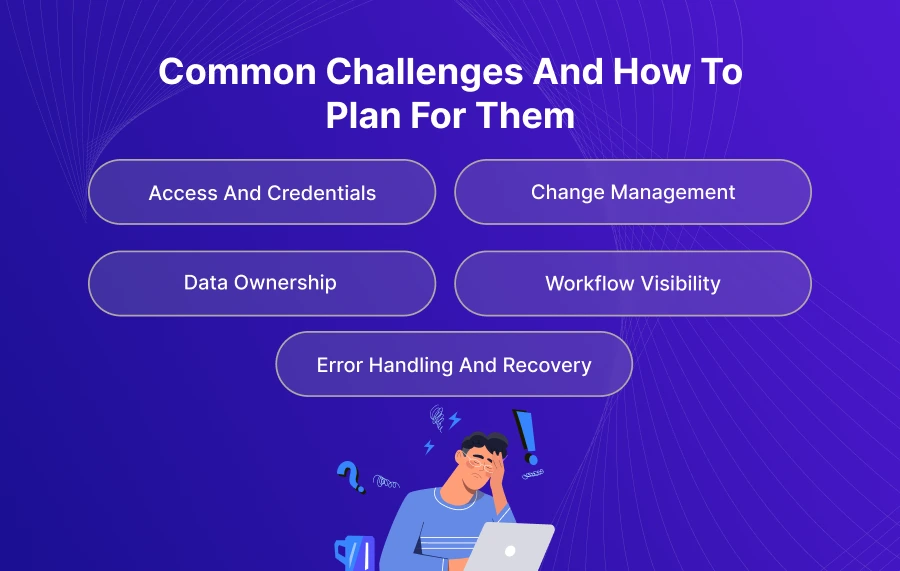
Access And Credentials
Every integration needs a secure way to reach connected systems, whether through API keys, OAuth tokens, service accounts, or certificates. A strong strategy defines how access is created, stored, rotated, and removed, and limits each integration to the data and actions it actually needs.
Business-critical workflows should not depend on an individual employee’s login. If that person changes roles or leaves, an order, invoice, or inventory workflow should keep running without disruption.
Change Management
SaaS applications change over time. APIs are updated, access rules evolve, fields are renamed, and usage limits shift. A strategy defines who tracks these changes, who tests updates, who approves production changes, and how the team responds when something breaks. Testing matters because one small field change can ripple across several workflows: a single customer field may touch sales, billing, fulfillment, reporting, and support.
Data Ownership
Data problems often begin when teams do not agree on which system owns which field. A customer record may live in CRM, ERP, support, and marketing tools, but that does not mean every system should control the same information. Sales contact details may belong in CRM, while billing terms and tax details belong in ERP. This matters most when SaaS application integration touches ERP and CRM data, because the same record can influence sales, finance, fulfillment, customer service, and reporting.
Workflow Visibility
Teams need enough visibility to understand what happened inside an integration: sync status, logs, failed records, retry history, and clear error messages. Without it, problems surface through customer complaints, stock mismatches, invoice delays, or month-end reconciliation. Visibility turns integration failures into manageable exceptions instead of operational surprises.
Error Handling And Recovery
Error handling should be part of the design from the start. A strategy should define which errors can be retried automatically, which need data correction, which need approval, and which require escalation. A failed order, invoice, payment, or inventory sync should have a clear recovery path. That is what keeps small failures from becoming larger operational issues.
SaaS Integration Strategy Best Practices
A strong SaaS integration strategy does not need unnecessary complexity. It needs clear ownership, practical governance, and a realistic view of how the business operates.
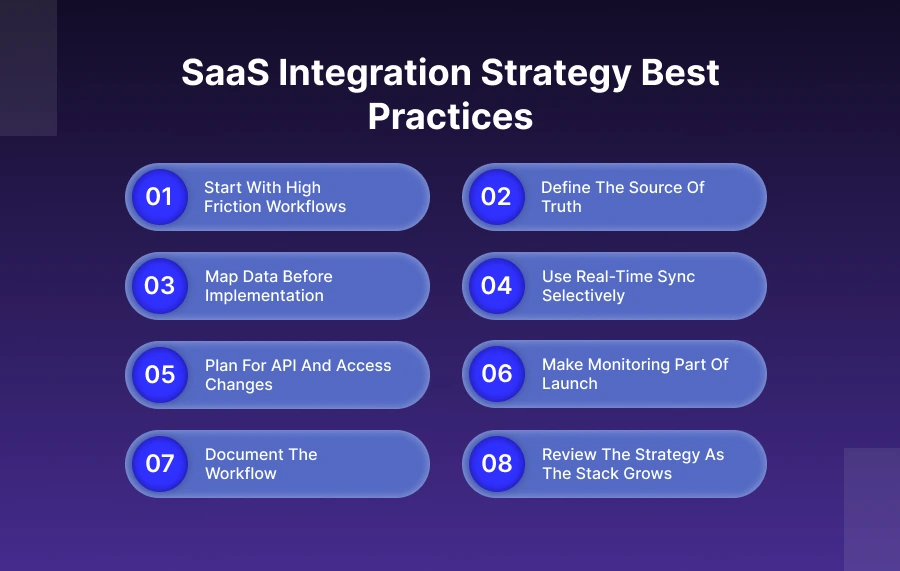
- Start With High-Friction Workflows: Prioritize workflows that create manual work, customer delays, revenue leakage, or reconciliation issues.
- Define The Source Of Truth: Decide which system owns key records such as customer, product, order, invoice, payment, shipment, and inventory.
- Map Data Before Implementation: Align on required fields, formats, validation rules, and field ownership before launch.
- Use Real-Time Sync Selectively: Fast sync matters for time-sensitive workflows, but scheduled sync may be better for reporting and lower-risk updates.
- Plan For API And Access Changes: Assign ownership for API updates, token rotation, credential changes, and connector testing.
- Make Monitoring Part Of Launch: Logs, alerts, retries, and error queues should ship with the first release, not after the first failure.
- Document The Workflow: Each integration should have an owner, a recovery path, and enough documentation for another team member to understand it.
- Review The Strategy As The Stack Grows: A five-application stack and a 30-application stack need different levels of governance.
Where A Governed iPaaS Fits
ERP-led businesses need integration workflows that protect operational accuracy. Orders, invoices, inventory, payments, and customer records cannot move between systems without clear rules, visibility, and recovery paths. This is where a governed iPaaS becomes relevant: it centralizes how data moves and how failures are handled, rather than leaving each connection to manage itself.
APPSeCONNECT helps businesses connect core applications around the ERP, keeping important operational data governed as it moves across systems. appse ai extends that foundation with AI-assisted workflow building, monitoring, mapping, and exception review.
APPSeCONNECT For Governed ERP-Led Integration
- ERP-Centered Workflow Design: Keeps ERP data at the center of connected workflows, which matters when finance, inventory, orders, and customer records need strong control.
- Visual ProcessFlow Designer: Teams can model integration workflows visually, making it easier to see how data moves between systems and where decisions happen.
- Sync Info And Snapshots: Sync status, logs, snapshots, node details, and API responses help teams identify where a workflow failed and what needs attention.
- Retry And Resync Options: Failed or missed records can be retried or resynced, helping teams recover transactions without rebuilding the workflow.
- Mapping And Validation Control: Teams can define how fields match, transform, and validate between systems, reducing the risk of incorrect downstream records.
- Hybrid Deployment Support: Cloud and on-premise agent options help businesses connect cloud applications while supporting specific environment or data-movement needs.
appse ai For AI-Assisted Workflow Control
- Autonomous Workflow Builder: Teams can describe the workflow they need in plain language, and appse ai helps create the structure with relevant systems, data objects, mapping, and error-handling logic.
- AutoDetect: Self-healing monitoring identifies failed records and known issue patterns, and surfaces alerts before small failures become larger cleanup tasks.
- SmartScript: Teams can generate transformation logic for routing, formatting, enrichment, currency conversion, and other data-handling requirements from natural-language descriptions.
- FlowInsight: Teams can understand what a workflow does, which systems it touches, and what data it processes without reviewing every configuration detail manually.
- Exception Review: Transaction context and error patterns help teams move from spotting a failed record to understanding what needs correction.
Together, APPSeCONNECT and appse ai help businesses move beyond basic connectivity into governed automation. That is most valuable when integrations involve ERP data, customer records, finance workflows, inventory movement, and high-volume operations.
Frequently Asked Questions
Start by defining system ownership for key records, then choose an approach that can scale beyond a single connection. Growing teams usually need shared monitoring, reusable mappings, clear error handling, and defined workflow ownership. For many mid-market businesses, iPaaS becomes more manageable than multiple native integrations or scattered custom scripts.
Native integrations work well for simple workflows. Custom code is useful when the business needs full control or has highly specific requirements. iPaaS is often the stronger option when teams need to manage several SaaS application integrations with better visibility, retry logic, and long-term maintainability.
Real-time sync is useful when delays affect customers, inventory, fulfillment, order status, or sales handoffs. Batch sync works well for reporting, scheduled updates, and lower-risk workflows. The decision should be based on how quickly the business needs to act on the data.
The biggest risks usually come from unmanaged access, over-permissioned accounts, exposed API keys, expired tokens, and poor visibility into what each integration can reach. A safer strategy controls access, limits permissions, and keeps clear records of how systems exchange data.
An integration may keep running, fail partly, reject records, or stop completely depending on the change. A strong strategy assigns ownership for API updates, connector testing, and recovery. Without that ownership, teams often discover issues only after important records stop syncing.
SaaS API integration connects applications through APIs so data and actions can move between systems. It is useful when a business needs more control than a basic native connector allows. The strategy should still cover access, field mapping, monitoring, retries, and API changes.
Start with the workflows that create the most operational friction, define the source of truth, map fields carefully, choose the right sync timing, and build monitoring into the launch plan. The strongest SaaS integration strategies also define who owns maintenance after the workflow goes live.
Conclusion
A SaaS integration strategy should help the business scale without creating fragile connections or recurring cleanup work. Native integrations, custom code, iPaaS, and embedded iPaaS each have a role, and the right choice depends on workflow complexity, system count, governance needs, and internal capacity.
The strongest strategy keeps data moving reliably as the stack grows, business rules change, and manual fixes become too expensive to sustain.
To know how APPSeCONNECT can help you integrate and automate your SaaS strategies and applications, book a demo to know more.