





API gateway management tools control how APIs are published, protected, monitored, and governed. A gateway manages live API traffic, while a full API management platform adds the wider layer around documentation, access, policies, analytics, and lifecycle control.
In 2026, the choice carries a new weight. AI agents are starting to call APIs directly, and Gartner expects more than 30% of the increase in API demand to come from AI and tools using large language models by 2026, so the right platform has to support AI-led workloads without weakening security, visibility, or governance. The strongest tool for your team is the one that matches your real workload, whether that is public APIs, internal microservices, cloud-native routing, AI traffic, or ERP-led business integration.
Key Takeaways
|
What Are API Gateway Management Tools?
API gateway management tools sit between API consumers and backend services. They decide who can access an API, how traffic is routed, how much usage is allowed, and how API activity is monitored. In the 2024 Gartner API Strategy Survey, 82% of organizations reported using APIs internally and 71% also used third-party APIs from SaaS vendors, so this control layer now governs a large and growing share of business traffic.
The gateway is the control layer for live API traffic. It checks each request, applies rules, and sends it to the right backend service.
An API management platform goes further. It treats APIs as long-term business and technology assets, adding documentation, developer access, versioning, policies, analytics, and governance.
API Gateway vs API Management Platform
Capability | API Gateway | API Management Platform |
Traffic routing | Sends API requests to the right backend service | Includes routing as part of a wider API program |
Access control | Applies keys, tokens, authentication, and rate limits | Manages access across apps, users, teams, and environments |
Developer portal | May be limited or added separately | Often includes docs, onboarding, subscriptions, and self-service access |
API lifecycle | Focuses on live runtime traffic | Covers design, publishing, versioning, governance, and retirement |
Analytics | Tracks traffic, errors, and performance | Adds usage trends, product-level reporting, and governance visibility |
Monetization | May support plans or quotas | Can package APIs as products with subscriptions and usage plans |
For a small engineering team, a gateway alone may be enough. For a growing API program, the management layer matters more, because APIs need owners, documentation, visibility, access control, and long-term governance.
What to Look for in an API Gateway Management Tool
A good tool should match the way your APIs are actually used. A company publishing partner APIs has different needs than a team running internal microservices, and a business preparing APIs for AI agents carries different risks again.
The core checklist still starts with security, routing, uptime, and traffic control. The newer layer is AI readiness. Gartner expects more than 80% of enterprises to have used generative AI APIs or deployed GenAI-enabled applications by 2026, up from less than 5% in 2023. When AI systems can call APIs, teams need stronger visibility, cleaner permissions, and tighter control over what those systems can do.
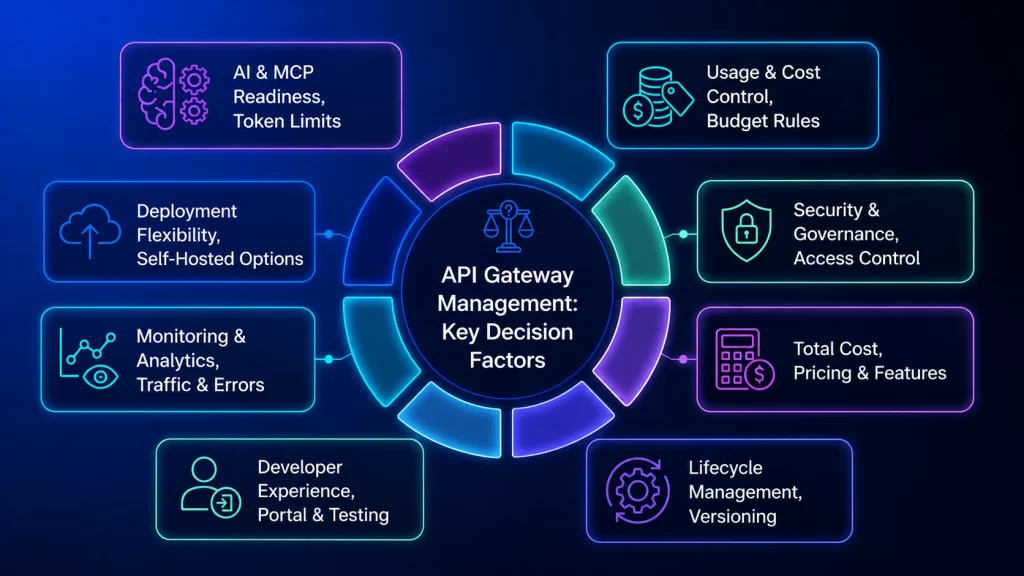
- AI and MCP readiness: Look for clear support for AI traffic, MCP servers, MCP proxies, or governed agent access. Treat vague AI claims with caution unless the vendor explains the actual capability.
- Usage and cost control: Traditional APIs are usually limited by request count. AI workloads may also need token limits, model usage controls, budget rules, and detailed activity logs.
- Deployment flexibility: Cloud-managed tools reduce infrastructure work. Self-hosted or hybrid tools help when private networking, compliance, latency, or data control matters.
- Security and governance: The platform should help with authentication, authorization, policy rules, audit trails, access control, and consistent governance across environments.
- Developer experience: A useful developer portal, clear documentation, self-service access, and testing tools reduce friction for API consumers.
- Lifecycle management: Mature API programs need versioning, publishing workflows, deprecation plans, ownership rules, and visibility across teams.
- Monitoring and analytics: Teams should see API traffic, errors, usage trends, and unusual activity. This matters even more once AI systems start calling APIs.
- Total cost: Pricing can vary by API calls, gateways, regions, users, environments, support, and advanced features. Compare platforms against your expected usage, not the entry-level plan.
API Gateway Management Tools at a Glance
Tool | Deployment Style | AI / MCP Readiness | Most Useful When |
Kong Konnect and Kong Gateway | Cloud, hybrid, self-managed | Strong AI Gateway and MCP direction | Teams govern API and AI traffic together |
Google Apigee | Google Cloud, hybrid | Clear MCP direction through Apigee and API hub | Large API programs need governance, portals, and API products |
Azure API Management | Cloud-managed, self-hosted gateway options | Strong AI gateway and MCP server direction | Microsoft-heavy teams need API and AI governance together |
Amazon API Gateway | Fully managed AWS service | Traditional API gateway focus | AWS teams need managed REST, HTTP, WebSocket, or serverless APIs |
Tyk | Open-source gateway, cloud, hybrid | Clear AI management and MCP gateway direction | Teams want flexible deployment and strong control |
Gravitee | Open-source and commercial options | REST-to-MCP and AI agent management direction | Teams want existing APIs to serve AI agent workflows |
KrakenD | Open-source core, enterprise features | Enterprise MCP server and AI gateway direction | Engineering teams prefer a config-driven gateway |
Zuplo | Cloud-native API management | MCP Gateway in public beta, plus AI Gateway direction | Lean teams need fast API, AI, and MCP governance |
MuleSoft Anypoint | Commercial platform | MCP, agent, and LLM server management direction | Enterprises want API management tied to integration |
IBM API Connect | SaaS and self-managed options | DataPower Interact Gateway for AI and MCP traffic | Regulated enterprises need structured API and AI control |
Solo Gloo and agentgateway | Kubernetes-native | AI, MCP, LLM, and agent traffic direction | Kubernetes platform teams manage traffic close to infrastructure |
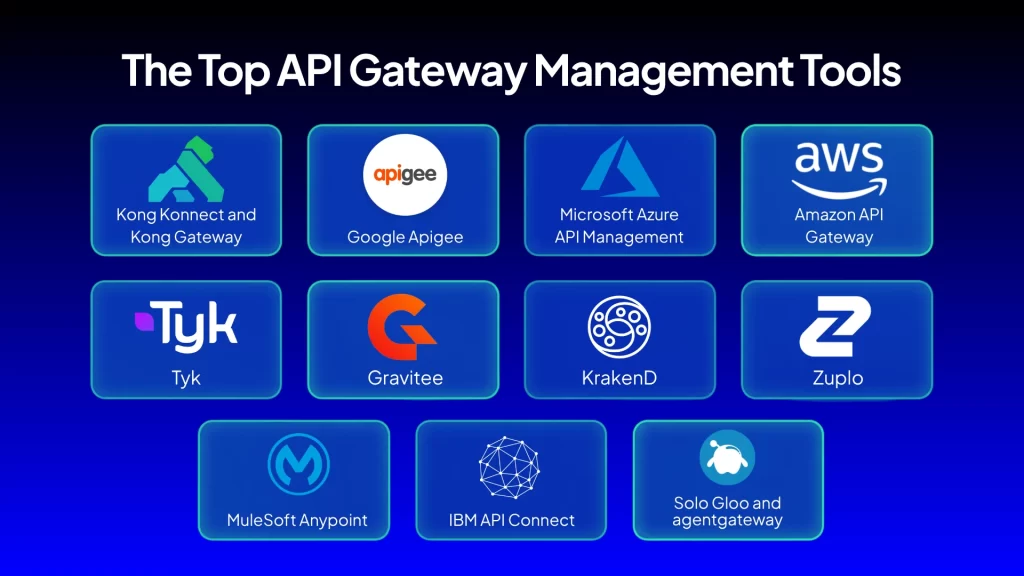
The Top API Gateway Management Tools
Kong Konnect and Kong Gateway
Kong works well for teams that need one control layer for traditional APIs and newer AI traffic. It can sit in front of backend services, apply policies, route requests, and help govern MCP access, which matters when internal apps, AI tools, and backend systems should not connect to each other without a governed front door.
- Strengths: Gateway policies, plugins, authentication, traffic control, observability, and hybrid deployment.
- Tradeoffs: Kong can become complex when ownership is unclear across policies, plugins, environments, and runtime operations.
- AI/MCP readiness: A clear AI Gateway direction and an AI MCP Proxy plugin for connecting Kong-managed services to MCP clients.
- Best for: Platform teams that want one gateway strategy for APIs, AI traffic, and MCP access.
2. Google Apigee
Apigee helps organizations manage APIs as long-term digital products. It fits teams that need developer portals, access control, API products, analytics, monetization, and governance, and its MCP direction makes it more relevant for AI-era API programs, since teams can prepare APIs for agent access while keeping discovery, control, and governance close to the management layer.
- Strengths: API lifecycle management, developer onboarding, API products, analytics, security policies, and governance.
- Tradeoffs: Can feel heavier than needed when the team only wants a simple gateway for routing and access control.
- AI/MCP readiness: Apigee and API hub include MCP-related capabilities for discovery, tools, authentication, and governed access.
- Best for: Enterprises that need mature API management and a structured API program.
3. Microsoft Azure API Management
Azure API Management helps Microsoft-heavy teams publish APIs, apply policies, manage access, use developer portals, and operate gateways across environments. Its AI gateway direction lets API and AI governance stay closer together instead of being handled through disconnected tools.
- Strengths: Works well with Azure services, Microsoft identity, API policies, developer portals, monitoring, and AI gateway use cases.
- Tradeoffs: Some features depend on service tier, gateway type, or availability, so confirm the exact features you need before shortlisting it.
- AI/MCP readiness: AI gateway and MCP server capabilities inside the existing API Management service.
- Best for: Microsoft-heavy teams that want API, AI, and MCP control in one familiar cloud environment.
4. Amazon API Gateway
Amazon API Gateway helps AWS teams create, publish, protect, monitor, and maintain APIs, and works especially well when APIs connect to Lambda or other AWS-hosted services. Treat it as a managed AWS gateway first: it handles traffic, access, API keys, throttling, quotas, monitoring, and REST, HTTP, or WebSocket APIs. For broader governance, developer portals, and API product management, teams may need additional AWS services or a separate management platform.
- Strengths: AWS serverless APIs, Lambda-backed services, HTTP APIs, REST APIs, WebSocket APIs, usage plans, API keys, and throttling.
- Tradeoffs: May not cover richer program needs such as advanced developer portals, cross-cloud governance, monetization, or full lifecycle management.
- AI/MCP readiness: Best treated as a traditional cloud API gateway; native MCP gateway capability was not verified for this comparison.
- Best for: AWS-first teams building serverless, web, mobile, or internal APIs.
5. Tyk
Tyk fits teams that want more control over deployment and gateway operations. It has an open-source foundation and runs across cloud, hybrid, and self-managed environments, and its AI and MCP direction suits teams that want governed access between AI assistants, internal APIs, and remote MCP servers.
- Strengths: Flexible deployment, an open-source gateway foundation, API governance, rate limiting, key management, and multi-protocol API control.
- Tradeoffs: Self-managed flexibility adds operational responsibility; the team still needs the skills to run, monitor, and govern the platform.
- AI/MCP readiness: Documented MCP server and MCP gateway capabilities, including governed access to remote MCP servers.
- Best for: Teams that want API management control without relying fully on one hyperscaler.
6. Gravitee
Gravitee helps teams manage APIs that go beyond basic REST endpoints, covering governance, plans, policies, developer access, and event-driven API patterns. Its AI agent direction suits companies that already have APIs and want to make them usable by AI agents: instead of rebuilding every API, teams can expose existing operations through MCP while keeping governance and visibility in place.
- Strengths: API lifecycle management, governance, multi-protocol API programs, plans, policies, and developer access.
- Tradeoffs: Some AI and MCP capabilities may depend on product edition, API type, or newer versions.
- AI/MCP readiness: Can expose API operations through an MCP server so AI agents discover and use them under governance.
- Best for: Teams that want existing APIs to become safer building blocks for AI agent workflows.
7. KrakenD
KrakenD fits engineering teams that prefer a lean, config-driven gateway. It suits teams that want to combine, transform, filter, secure, and route API calls without adopting a heavy platform around the gateway, and it works best when infrastructure and configuration ownership are clear. It is less aligned with teams that mainly want a polished business-facing developer portal or a broad API product suite.
- Strengths: Stateless design, declarative configuration, request aggregation, transformations, filtering, throttling, authentication, and strong gateway control.
- Tradeoffs: Teams may need additional tools for a full developer portal, API monetization, or a business-facing API lifecycle experience.
- AI/MCP readiness: KrakenD Enterprise includes MCP server capabilities that expose existing services as MCP tools.
- Best for: Engineering teams that want a fast, controlled, configuration-led gateway.
8. Zuplo
Zuplo helps teams put API management in place without a long platform rollout. It is developer-friendly and useful when teams need policies, authentication, rate limits, documentation, analytics, and a developer portal in a managed setup. Its MCP Gateway suits teams testing agent workflows, though its beta status should be checked carefully before production-critical work.
- Strengths: Developer-friendly setup, managed gateway workflows, policy control, developer portal support, analytics, AI Gateway direction, and MCP Gateway experimentation.
- Tradeoffs: Teams with strict self-hosting, private networking, or heavy compliance requirements should confirm whether Zuplo matches their operating model.
- AI/MCP readiness: The MCP Gateway is in public beta and can front remote MCP servers through a governed endpoint.
- Best for: Lean platform teams and API-first teams that want speed, governance, and modern AI/MCP readiness.
9. MuleSoft Anypoint
MuleSoft Anypoint helps enterprises connect APIs, integrations, reusable assets, governance, and operational workflows under one broader platform, and is strongest when API management is part of a larger integration strategy. For a team that only needs a lightweight gateway, it may be more platform than required; for a company already using MuleSoft for important integrations, API Manager can strengthen governance around those APIs.
- Strengths: API lifecycle management, integration reuse, governance, policies, monitoring, Exchange, and enterprise-scale operating models.
- Tradeoffs: May be too broad for teams that only need routing, authentication, and basic rate limits.
- AI/MCP readiness: API Manager includes management areas for agents, MCP servers, and LLM servers through Omni Gateway-related capabilities.
- Best for: Enterprises that want API management connected closely with integration, governance, and reuse.
10. IBM API Connect
IBM API Connect helps large organizations manage API security, governance, portals, analytics, and control, and is especially relevant for teams already using IBM and DataPower. Its AI-era value is tied to IBM DataPower Interact Gateway, which helps organizations govern LLM provider access and create MCP tools and servers from existing API definitions.
- Strengths: Regulated environments, governance-heavy API programs, developer portals, analytics, DataPower alignment, and controlled enterprise operations.
- Tradeoffs: Smaller teams may find it heavier than needed unless they already use IBM infrastructure or need deep governance.
- AI/MCP readiness: A clear AI Gateway MCP direction through DataPower Interact Gateway.
- Best for: Large, regulated, IBM-aligned enterprises that need governed API and AI interaction control.
11. Solo Gloo and agentgateway
Solo helps platform teams working deeply with Kubernetes, Envoy, and the Kubernetes Gateway API. It suits teams that manage API traffic, service traffic, and platform networking close to the Kubernetes layer, and its agentgateway direction matters because many AI workloads now run in cloud-native environments. Teams that route MCP, LLM, HTTP, and agent traffic near the platform layer may find it useful.
- Strengths: Kubernetes-native architecture, Envoy-based traffic control, Gateway API alignment, security, observability, and platform engineering workflows.
- Tradeoffs: Not the easiest path for teams that want a simple SaaS API management platform with minimal infrastructure responsibility.
- AI/MCP readiness: Solo Enterprise for agentgateway is built around routing traffic to MCP, LLM, HTTP, and agent backends.
- Best for: Kubernetes platform teams that want API and AI traffic control close to their infrastructure.
How to Choose by Workload and Team
The right API gateway software depends on the work it needs to support. A public API program, an AWS serverless app, an internal AI agent workflow, and an ERP integration setup all create different requirements. Start from the cloud you run and the job the APIs do, then weigh deployment model, governance depth, and cost.
Workload | Strong Shortlist | Why It Helps |
AWS serverless APIs | Amazon API Gateway | Works naturally with AWS services, Lambda, HTTP APIs, REST APIs, WebSocket APIs, and throttling |
Azure and Microsoft AI workloads | Azure API Management | Connects well with Microsoft identity, Azure services, AI gateway needs, and MCP server use cases |
Full API programs | Apigee, MuleSoft, IBM API Connect, Kong, Tyk, Gravitee | Helps with portals, governance, analytics, API ownership, and lifecycle management |
Kubernetes platform teams | Solo Gloo, Kong, Tyk, Gravitee, KrakenD | Gives infrastructure teams stronger control over runtime traffic and policies |
AI agents calling APIs | Kong, Azure API Management, Gravitee, Zuplo, Tyk, IBM API Connect, KrakenD | Adds clearer direction around AI gateway, MCP, or agent access |
Lean developer teams | Zuplo, Amazon API Gateway, Azure API Management | Reduces setup effort while covering core gateway and management needs |
ERP and business app integration | APPSeCONNECT | Helps connect ERP, CRM, eCommerce, finance, marketplace, and operational systems |
AI/MCP readiness matters most when AI agents need to call APIs or tools safely, and when teams need logs, permissions, cost controls, and visibility for AI-driven activity. It matters less when an API only serves a website, mobile app, partner app, or internal service with no agentic use case.
- Choose cloud-managed: When your team wants less infrastructure work and a faster path to production.
- Choose self-hosted or hybrid: When private networking, compliance, latency, or data control matters.
- Choose full lifecycle API management: When APIs need owners, documentation, portals, usage controls, versioning, and governance.
- Choose a developer gateway: When engineers mainly need routing, authentication, rate limits, transformations, monitoring, and deployment speed.
- Choose an integration platform: When the bigger problem is keeping business systems in sync, not publishing APIs as products.
How APPSeCONNECT and appse ai Help API-Led Integration Workflows
Many businesses evaluating API management tools are not trying to build a public API program. They are trying to fix the operational gaps that appear when ERP, CRM, eCommerce, finance, marketplace, and shipping systems hold different versions of the same data.
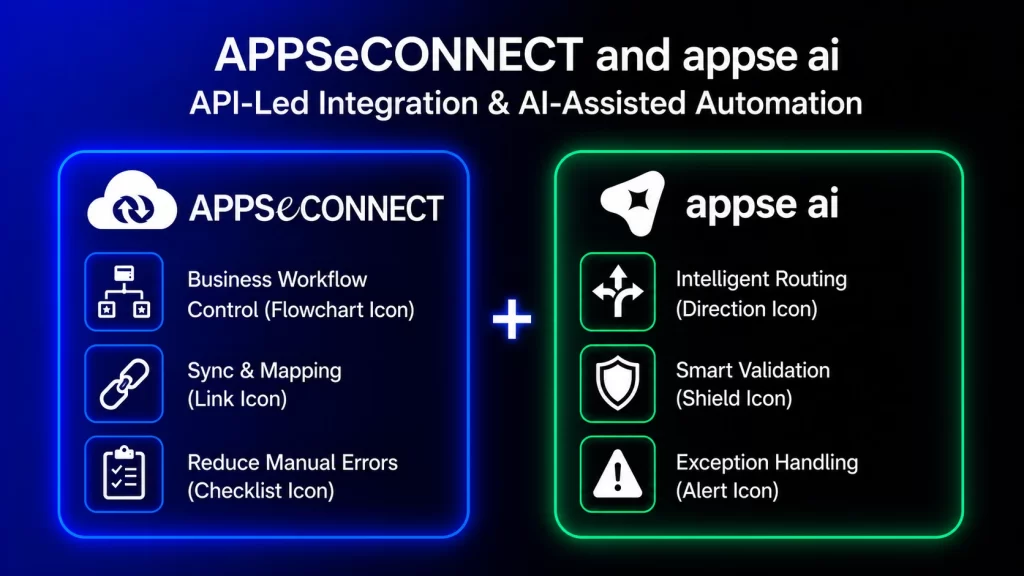
APPSeCONNECT helps businesses connect their core systems and automate the workflows that depend on them. Orders move from the storefront to the ERP, inventory updates reach sales channels, and customer and invoice data stays aligned across operations. Teams spend less time chasing mismatched records and more time running the business.
The API layer still matters here. Business applications rely on APIs to exchange data, but the buyer outcome is not only traffic control. The buyer needs reliable sync logic, mapping, workflow rules, monitoring, error handling, and support for the systems that run daily operations.
appse ai extends that connected foundation with AI-assisted automation. Once business systems are connected, AI can help teams move from basic data sync to smarter operational workflows, including routing, validation, exception handling, and broader automation across connected apps.
For teams managing public APIs, developer portals, edge routing, or gateway-level AI and MCP traffic, a dedicated API gateway platform may remain the primary layer. For ERP-led automation and cross-application workflow control, APPSeCONNECT and appse ai help solve the business-system side of the problem.
- Business focus: APPSeCONNECT helps ERP-centric teams connect commerce, CRM, finance, marketplaces, and operations.
- Operational value: Teams can reduce manual data entry, duplicate records, order delays, inventory mismatch, and disconnected reporting.
- API value: API-led integration becomes useful because it supports real business workflows, not because APIs exist as standalone assets.
- AI value: appse ai helps extend connected workflows into AI-assisted automation across business operations.
- Buyer check: Confirm exact API management scope, Unified API capabilities, MCP posture, AI gateway posture, deployment options, and compliance requirements before comparing it directly with dedicated gateway platforms.
Frequently Asked Questions
No. An API gateway handles live API traffic: it routes requests, checks access, applies rate limits, and helps protect backend services. An API management platform includes the gateway but adds the larger management layer, which can cover API design, documentation, developer portals, versioning, analytics, access plans, governance, and monetization.
An AI gateway controls traffic between applications and AI services such as LLMs, AI agents, model APIs, and MCP servers. It helps teams manage who can access AI systems, how usage is tracked, which models are called, how costs are controlled, and how activity is logged. The core value is control: instead of every team connecting directly to AI tools, the company gets one governed access layer.
MCP, or Model Context Protocol, gives AI agents a more standard way to discover and use tools, APIs, and data sources. It matters when agents need to take action across real systems. Without control, every MCP server can become its own access point. With the right gateway or management layer, teams can apply authentication, permissions, logging, and usage rules.
MCP support matters if AI agents need to call your APIs, access internal tools, or work across multiple business systems. It may not matter yet if your APIs only serve websites, mobile apps, partner apps, or internal services. In that case, traditional API gateway controls may be enough for now.
Kong Gateway, Tyk, Gravitee, and KrakenD are common open-source or open-core tools buyers compare. Kong and Tyk are strong when teams want a broad gateway ecosystem, Gravitee is useful when lifecycle management and multi-protocol APIs matter, and KrakenD works well for engineering teams that want a lean, declarative gateway.
Cloud-managed API management is easier to start with, since the vendor handles more of the platform operations, updates, and control plane work. Self-hosted or hybrid deployment makes more sense when the team needs private networking, regional control, lower latency, strict compliance, or tighter infrastructure ownership.
API management pricing can depend on API calls, environments, regions, gateways, users, support level, deployment model, and advanced features. The safest way to compare cost is to model your own expected usage, including traffic volume, number of environments, gateway locations, developer users, support needs, and any AI or MCP features you expect to use.
For developer-led API programs, tools like Apigee, Azure API Management, Kong, Tyk, Gravitee, MuleSoft, IBM API Connect, and Zuplo help manage multiple APIs with stronger governance and visibility. For business-system integration across ERP, CRM, eCommerce, finance, marketplaces, and shipping apps, APPSeCONNECT may be the better fit, because the work is more about data mapping, sync reliability, workflow automation, and operational control.
The Right Tool Matches the Job, Not the Feature List
API gateway management tools now cover far more than routing and access control. The right platform should match the real workload, whether that is public APIs, internal services, cloud-native routing, AI traffic, MCP access, or ERP-led integration. Choose based on the job your team needs to solve, not the longest feature list.
To know how APPSeCONNECT can help you keep your ERP, CRM, eCommerce, Finance, and Operations aligned while still managing all the API challenges, book our demo to know more.