It's 4:30 PM on Friday. You are about to head out for the weekend.
Then the notification hits your phone:
Someone just ordered “10 units of your best-selling SKU. A $2,000 order.”
You smile until your warehouse manager texts you:
"We are out. Last one shipped this morning."
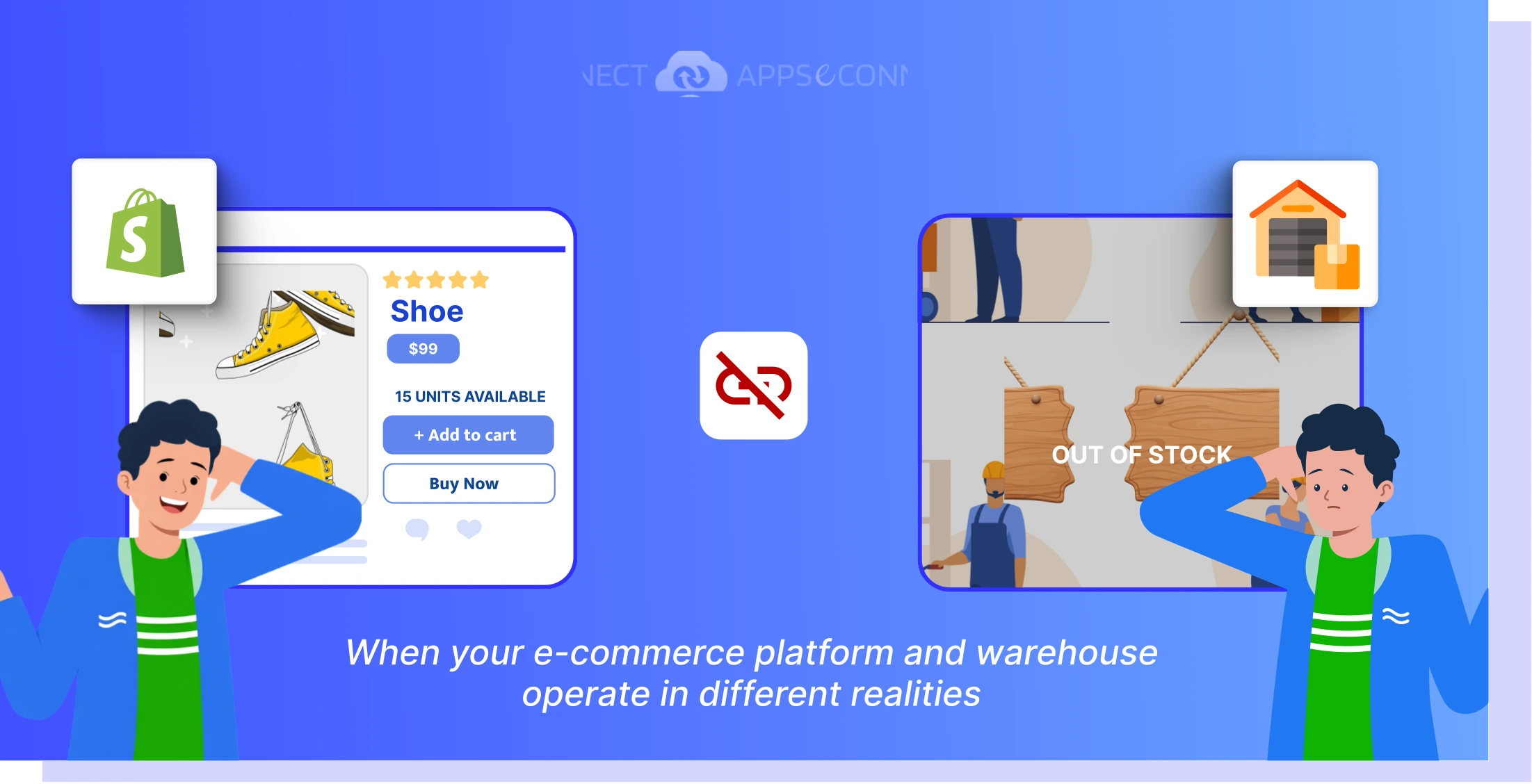
But your Shopify store shows 15 units available. It is showing that all day.
Now you have three terrible options
Option 1: Cancel the order. Lose the $2,000 sale. Lose the customer. Watch them leave a 1-star review about your "phantom inventory."
Option 2: Call your supplier. Beg them to rush ship 10 units for 3x the normal cost. Accept that this $2,000 sale will actually lose you money.
Option 3: Let it ride. Ship what you can next week. Deal with the angry customer emails on Monday morning.
Sound familiar?
If you are running an e-commerce business with an ERP system, this scenario isn't hypothetical; it isTuesday!!!
THE PAIN POINTS
This isn’t just a Friday afternoon problem. This is every day of running a disconnected e-commerce operation.
Let me walk you through what is actually happening in your business right now:
The Monday Morning Spreadsheet Marathon
Every Monday morning, like clockwork:
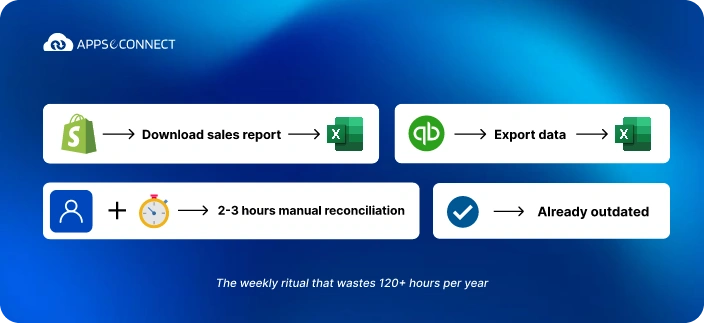
8:30 AM - Your warehouse manager logs into Shopify and downloads Friday's sales report
8:45 AM - Your accounting team exports the same data from QuickBooks
9:00 AM - Someone opens Excel and starts the manual reconciliation
9:00 AM - 11:30 AM - They are matching order numbers, checking quantities, fixing discrepancies
11:30 AM - The inventory counts are finally "accurate"
11:31 AM - They are already wrong again because 6 new orders came in while they were reconciling
This happens every single Monday!!!
Your team spends 2-3 hours doing work that should take 30 seconds. And by the time they finish, the data is already outdated.
The "Can We Ship This?" Slack Thread
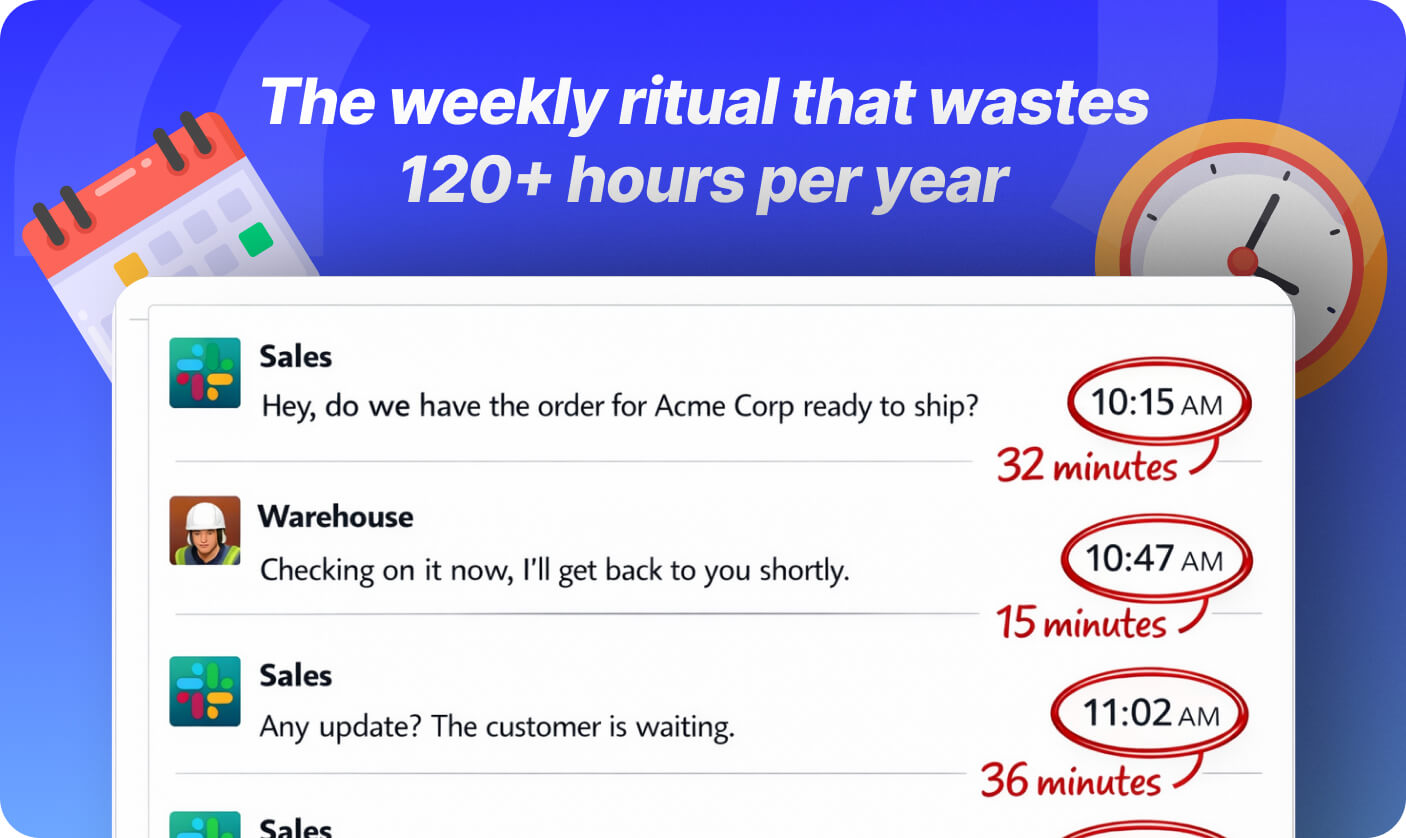
Here's how a simple customer question turns into a 45-minute ordeal:
Sales team: "Customer wants 50 units by next week. Do we have it?"
Warehouse: "Let me check..."
(30 minutes pass)
Warehouse: "We have 35 here, maybe 20 at the other location?"
Sales: "Maybe? Can you confirm?"
Warehouse: "I'll call them and get back to you..."
Meanwhile, your customer needed an answer in 5 minutes. They didn't get one. So they went to your competitor who answered immediately.
You just lost a $4,500 order because your inventory data lives in silos!!!
The Double-Entry Death March
Order #4729 comes into Shopify at 10:15 AM.
But your warehouse does not see it. Your ERP doesn't know about it. Your fulfillment team is working blind.
Finally, at 2:00 PM, someone manually enters it into NetSuite.
But Sarah's rushing because she has 47 other orders to enter.
She makes a typo in the shipping address. 123 Main Street becomes 132 Main Street
The wrong product ships to the wrong address.
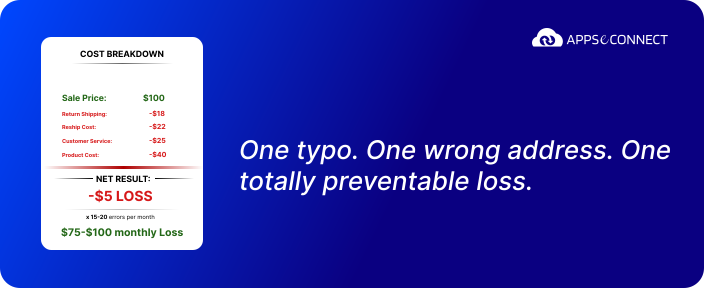
Now you are paying:
Return shipping: $18
Reship cost: $22
Customer service time: $25
The goodwill you lost: Priceless
That $100 order just cost you -$85.
And this happens 15-20 times per month
"Which Number is Right?" Finance Nightmare
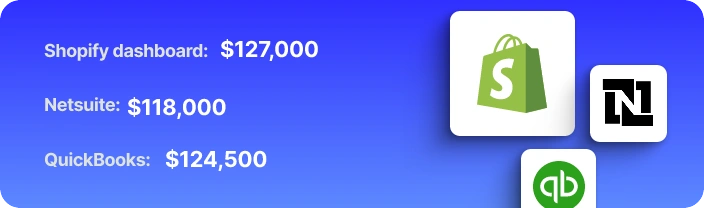
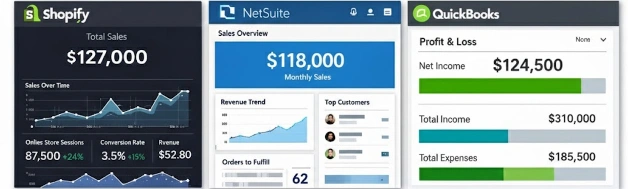
End of month. Your CFO needs the revenue number for the board presentation.
"So... which is correct?"
You spend 8 hours tracking down the $9,000 discrepancy.
The answer? It was 47 orders that were fulfilled but never entered into the ERP. Someone forgot. Someone was out sick. Someone was "going to do it later."
Now your financials are wrong. Your board presentation is delayed. Your CFO doesn't trust your numbers.
All because your systems don't talk to each other.
Three systems. Three different truths. Zero confidence.
?
Which is correct
The Oversell Disaster
You're selling on Shopify, Amazon, and eBay. Smart diversification, right?
You have 5 units left of SKU #8472.
But here's what your customers see:
All three platforms sell out simultaneously.
You've just promised 15+ units to customers when you only have 5.
Now you're sending refund emails, apologizing, watching the 1-star reviews roll in.
Average cost per oversell:
$250 (refund + lost customer lifetime value + negative review impact)
Frequency: 5-10 times per month
Annual cost: $15,000-$30,000
One inventory count. Three platforms. Fifteen angry customers.
Let's add it all up. Here's what disconnected systems are actually costing you:
Labor Waste
15-20 hours per week on manual data entry, reconciliation, and fixing errors
= $15,000-$20,000 per year
Overselling Incidents
5-10 oversells per month at $250 per incident (refunds + lost customers)
= $15,000-$30,000 per year
Stockouts from Bad Data
Lost sales when inventory shows zero but you actually have stock = 10-15% of potential revenue
= $25,000-$75,000 for a $5M business
Errors and Corrections
Wrong addresses, wrong products, returns, reships, customer service time
= $10,000-$25,000 per year
TOTAL ANNUAL COST
$65,000-$150,000
And that's just the measurable costs. What about:
The customers you've lost to competitors?
The wholesale accounts that won't place orders because "you can never tell me if you have stock"?
The time your leadership team wastes in meetings trying to figure out which numbers are real?
The hidden cost of disconnected systems (and this is conservative)
Here's the thing: None of this is your fault.
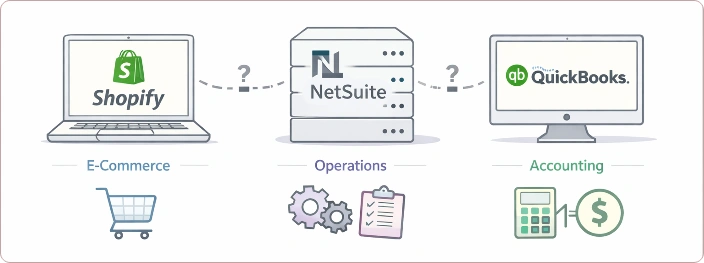
You built a business. You added tools as you needed them. Shopify for e-commerce. NetSuite for operations. QuickBooks for accounting. Each one is great at what it does.
The problem? They don't talk to each other.
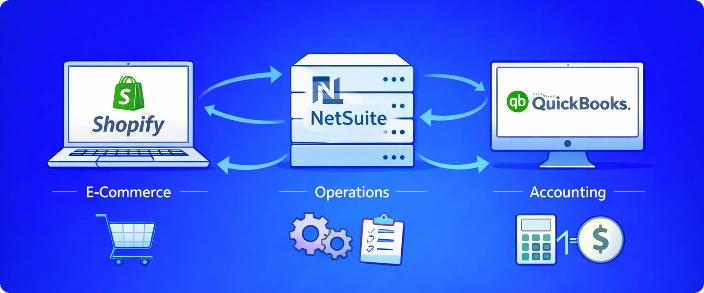
But what if they could talk to each other?
Imagine this instead:
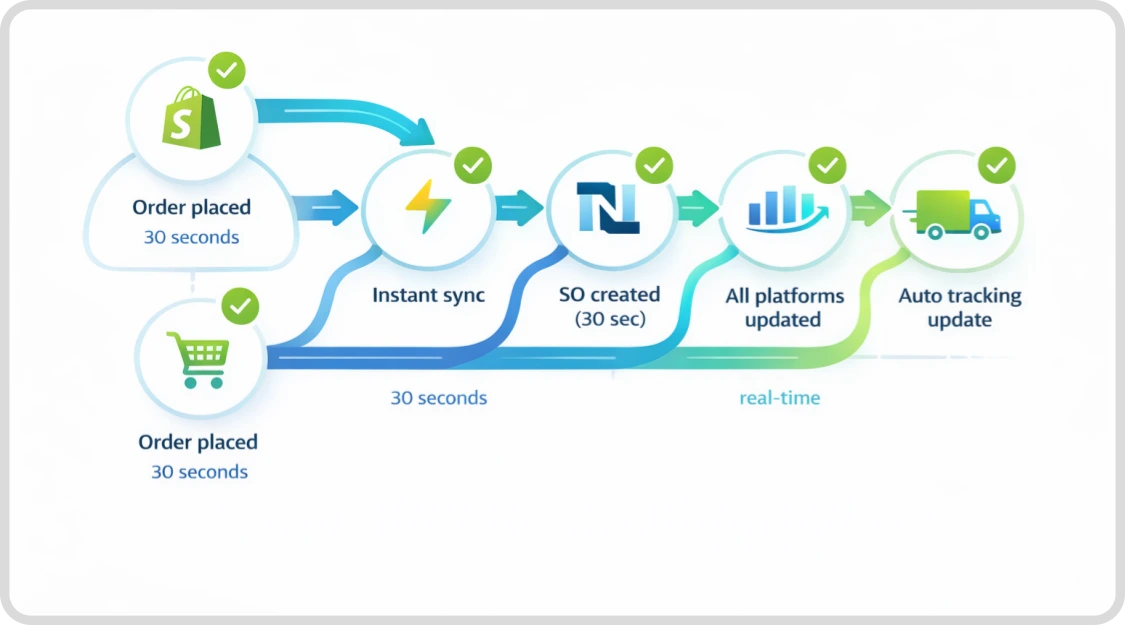
orders on Shopify at 10:15 AM
Inventory automatically decremented across all platforms in real-time
Sales order automatically created in NetSuite at 10:15:30 AM (30 seconds later)
Fulfillment team sees the order immediately with correct address
When item ships, tracking number automatically updates in Shopify
Customer gets shipping notification, your finance team gets the data, everyone sees the same truth
No manual entry. No delays. No errors. No spreadsheet marathons.
Your warehouse, finance, and sales teams all looking at the same number, and it's always correct.
You're not alone in this problem, and you're not alone in solving it.
We've helped hundreds of mid-market e-commerce companies integrate Shopify, Magento, and WooCommerce with NetSuite, SAP B1, Acumatica, and other ERPs.
Here's what they're saying:
"We were spending 20+ hours every week manually entering orders from Shopify into NetSuite. Now it happens in real-time. We redeployed that entire team member to customer experience work. The integration paid for itself in the first month."
— Sarah Chen, Operations Director
MidWest Industrial Supply ($8M revenue)
"Before APPSeCONNECT, we were overselling 8-12 times per month. Every oversell was a customer service nightmare and a hit to our reputation. We haven't had a single oversell in 6 months. Our marketplace ratings went from 4.2 to 4.8."
— Marcus Thompson, E-commerce Manager
Peak Outdoor Gear ($12M revenue)
"Month-end close used to take us 8-10 days. We'd be reconciling Shopify sales with NetSuite data manually. Now? Our books close in 2 days. Our CFO gets accurate numbers when she needs them, not when we finally finish the spreadsheet."
— Jennifer Martinez, Controller
Urban Home Decor ($6M revenue)
Real results from real mid-market e-commerce companies
Ready to stop the Friday 4:30 PM panic?
Let's show you exactly how this works with YOUR systems.
We're offering personalized 15-minute integration demos where we'll:
✓ Map out your current Shopify → ERP workflow
✓ Show you exactly how APPSeCONNECT handles your specific use case
✓ Walk through live examples using your actual data structure
✓ Answer your technical questions (bring your IT team if you want)
✓ Give you a clear timeline and pricing for your specific integration
No pressure. No sales pitch. Just answers.
We'll show you the integration running live. You'll see orders flowing from Shopify to NetSuite in real-time. You'll see inventory syncing across platforms. You'll see what "fully automated" actually looks like.
Think about what you could do with an extra 15-20 hours per week.
Think about never sending another oversell apology email.
Think about your CFO actually trusting your revenue numbers.
That's what we're offering to show you.
Click below to grab a time that works for you. We have slots available this week and next.








 orders on Shopify at 10:15 AM